


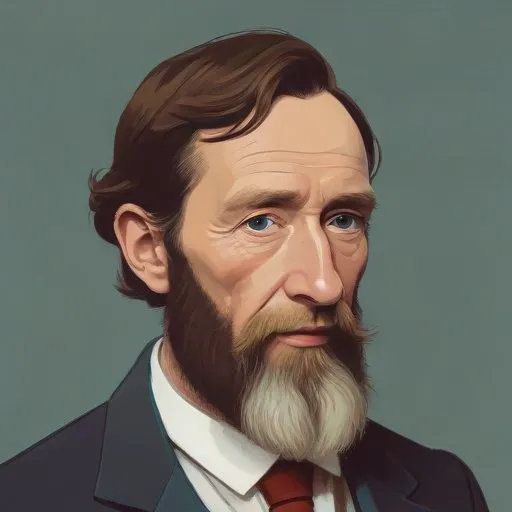
A pioneering physicist who made significant contributions to the discovery of the greenhouse effect and the behavior of gases, and an accomplished mountaineer who conquered several Alpine peaks.
John Tyndall, a 19th-century Irish physicist, is renowned for his groundbreaking discoveries in the realms of diamagnetism, infrared radiation, and the physical properties of air. His most significant contribution, however, lies in his pioneering work on the connection between atmospheric CO2 and the greenhouse effect, laying the foundation for our modern understanding of climate change.
Tyndall was born on August 2, 1820, in Leighlinbridge, County Carlow, Ireland, to a local police constable. He attended the local schools, Ballinabranna Primary School in County Carlow, and later became an assistant teacher. His early education equipped him with skills in technical drawing and mathematics, which he would later apply to land surveying.
In 1839, Tyndall was hired as a draftsman by the Ordnance Survey of Ireland, and later moved to work for the Ordnance Survey for Great Britain in 1842. During the 1840s, he leveraged his land surveying experience to work on railway construction planning, earning a lucrative income. However, his desire for intellectual growth led him to become a mathematics and surveying teacher at Queenwood College, a boarding school in Hampshire, in 1847.
Tyndall's scientific fame arose in the 1850s with his study of diamagnetism, a phenomenon where certain materials exhibit a weak repulsion to magnetic fields. His work in this area earned him recognition and paved the way for his later discoveries.
In the 1850s and 1860s, Tyndall conducted a series of experiments on infrared radiation, demonstrating the existence of heat rays and their interaction with various materials. His findings contributed significantly to the understanding of the physical properties of air and the behavior of gases.
In 1859, Tyndall's most seminal work, "On the Absorption and Radiation of Heat by Gases," revealed the connection between atmospheric CO2 and the greenhouse effect. Through his experiments, he demonstrated that CO2 traps heat, leading to an increase in global temperatures. This discovery has had a profound impact on our understanding of climate change and its consequences.
Tyndall was elected as a member of the American Philosophical Society in 1868 and held the position of professor of physics at the Royal Institution of Great Britain in London from 1853 to 1887. He was also a fellow of the Royal Society and received the Royal Medal in 1853 for his work on diamagnetism.
Tyndall's contributions to science have had a lasting impact on our understanding of the natural world. His work on the greenhouse effect has been instrumental in shaping modern climate science, and his legacy continues to inspire new generations of scientists and researchers.
Through his extensive writings and lectures, Tyndall brought complex scientific concepts to a wider audience, making him an influential figure in the development of popular science. His commitment to education and public engagement has left an indelible mark on the scientific community.
Today, John Tyndall is recognized as a pioneering figure in the field of physics, and his groundbreaking work on the greenhouse effect continues to inform our understanding of the complex relationships between the atmosphere, climate, and human activity.
John Tyndall's remarkable career and groundbreaking discoveries have left an enduring legacy in the scientific community. His work continues to inspire new generations of scientists, researchers, and educators, cementing his place as one of the most influential physicists of the 19th century.
Born in 1831
Developed groundbreaking theories that unified electricity and magnetism, and predicted the existence of radio waves, revolutionizing our understanding of the physical world.
Born in 1791
Pioneering scientist who discovered electromagnetic induction, formulated the laws of electrolysis, and invented the first electrical generator, revolutionizing our understanding of electricity and its applications.
Born in 1822
Developed the theory of thermodynamics, introducing the concept of entropy, and made significant contributions to the fields of electricity and magnetism.
Born in 1818
A pioneer in thermodynamics, he discovered the relationship between mechanical work and heat, leading to the development of the laws of thermodynamics. His work laid the foundation for modern physics and engineering.
Born in 1864
Developed groundbreaking geometric methods that transformed our understanding of space and time, and his work laid the foundation for Einstein's theory of relativity.
Born in 1879
A brilliant physicist who developed the theory of relativity and is considered one of the most influential scientists of the 20th century, known for his groundbreaking work in physics and mathematics.
