


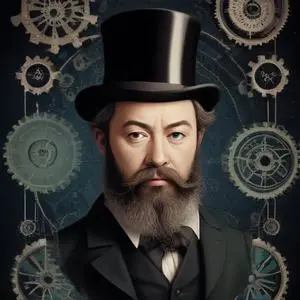
A pioneer in thermodynamics, he discovered the relationship between mechanical work and heat, leading to the development of the laws of thermodynamics. His work laid the foundation for modern physics and engineering.
James Prescott Joule is renowned for his groundbreaking discovery of the relationship between heat and mechanical work, leading to the fundamental law of conservation of energy. This pioneering work not only earned him a place among the greatest scientists of his time but also led to the development of the first law of thermodynamics.
Joule was born on December 24, 1818, in Salford, Lancashire, to a wealthy brewer, Benjamin Joule, and his wife, Alice Prescott. His early years were marked by a fascination with electricity, and he was fortunate to be tutored by the famous scientist John Dalton. Joule's curiosity was further fueled by the works of chemist William Henry and Manchester engineers Peter Ewart and Eaton Hodgkinson.
As an adult, Joule managed the family brewery, but science remained his true passion. He began to investigate the feasibility of replacing the brewery's steam engines with electric motors, leading to his first scientific papers on the subject. Joule's work was motivated by both business acumen and scientific curiosity, driving him to determine which prime mover was more efficient.
In 1841, Joule discovered his first law, which states that the heat evolved by the proper action of any voltaic battery is proportional to the chemical work performed. This breakthrough led to the development of the law of conservation of energy, a fundamental concept that transformed the understanding of energy and its interactions.
Joule worked closely with Lord Kelvin to develop an absolute thermodynamic temperature scale, which became known as the Kelvin scale. His collaborations didn't stop there; Joule also made significant observations on magnetostriction and found the relationship between current through a resistor and heat dissipated, now known as Joule's first law.
Joule's contributions to science were recognized with numerous awards, including the Copley Medal in 1860 and the Royal Medal in 1852. The SI derived unit of energy, the joule, is a testament to his lasting impact on the scientific community.
Joule's experiments on energy transformations were first published in 1843, marking the beginning of a new era in scientific understanding. Throughout his life, Joule remained dedicated to his work, publishing numerous papers and continuing to contribute to the scientific community until his death on October 11, 1889.
Joule's work has had a lasting impact on modern society, from the development of more efficient engines to the understanding of energy conservation. His legacy continues to inspire new generations of scientists, engineers, and innovators.
Joule's remarkable story serves as a testament to the power of human curiosity and innovation. His groundbreaking work continues to shape our understanding of energy and its role in shaping our world.
Born in 1791
Pioneering scientist who discovered electromagnetic induction, formulated the laws of electrolysis, and invented the first electrical generator, revolutionizing our understanding of electricity and its applications.
Born in 1879
A brilliant physicist who developed the theory of relativity and is considered one of the most influential scientists of the 20th century, known for his groundbreaking work in physics and mathematics.
Born in 1867
A pioneering scientist who pioneered radioactivity research, discovering elements polonium and radium, and paving the way for breakthroughs in medicine and energy.
Born in 1856
A pioneering engineer who harnessed the power of alternating current (AC) to transform the world's electrical systems, and is credited with developing groundbreaking technologies like radio communication and X-ray imaging.
Born in 1847
A pioneer in innovation, credited with developing groundbreaking inventions that revolutionized the way people live and communicate, including the light bulb and phonograph.
Born in 1831
Developed groundbreaking theories that unified electricity and magnetism, and predicted the existence of radio waves, revolutionizing our understanding of the physical world.
Born in 1821
A 19th-century physician and physicist who made significant contributions to the fields of electromagnetism, thermodynamics, and the physiology of human perception, particularly in the study of vision and hearing.
Born in 1822
Developed the theory of thermodynamics, introducing the concept of entropy, and made significant contributions to the fields of electricity and magnetism.
