


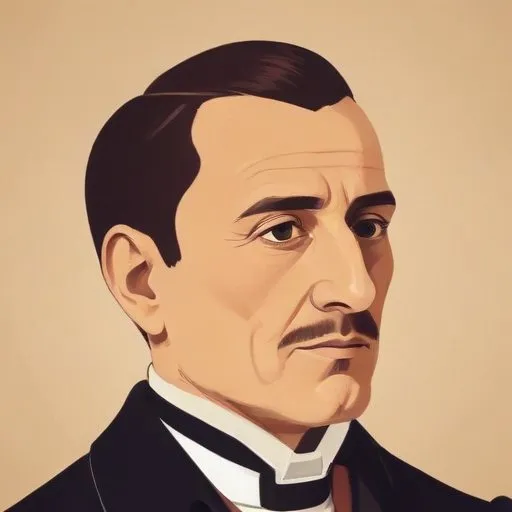
A 17th-century Italian Jesuit who mapped and documented China's geography, creating some of the most accurate and influential maps of the region during his time. He also wrote extensively on Chinese history and culture.
Martino Martini, a 17th-century Jesuit missionary, is renowned for his groundbreaking cartographic and historical contributions to the understanding of ancient Imperial China. Through his meticulous mapping and scholarly writings, Martini left an indelible mark on the field of Sinology, shedding light on the complexities of Chinese geography, politics, and culture.
Born in Trento, Prince-Bishopric of the Holy Roman Empire, on September 20, 1614, Martini was destined for a life of scholarship and service. After completing his high school education in Trento, he joined the Society of Jesus in 1631, embarking on a journey that would take him to Rome, Portugal, and eventually, China.
In Rome, Martini studied classical literature and philosophy at the Roman College, where he developed a fascination with astronomy and mathematics under the guidance of Athanasius Kircher. This foundation in scientific inquiry would later serve him well in his cartographic endeavors.
In 1640, Martini set out for China, arriving in Portuguese Macau in 1642. During his time in Macau, he devoted himself to studying Chinese, laying the groundwork for his future interactions with the imperial court and regional authorities.
In 1643, Martini crossed into mainland China, settling in Hangzhou, Zhejiang Province. From this base, he traveled extensively, gathering scientific information and producing meticulous maps of the Chinese empire. His journeys took him to Peking, the Great Wall, and various provinces, allowing him to develop a profound understanding of China's geography and politics.
Martini's most significant contribution to the field of cartography lies in his Ovum Mundorum, a comprehensive atlas of China, which presented the most accurate and detailed maps of the region at the time. This work not only facilitated European understanding of China's geography but also served as a valuable resource for subsequent explorers and scholars.
Martini's presence in China during the fall of the Ming dynasty and the rise of the Qing dynasty provided him with a unique perspective on this pivotal moment in Chinese history. His writings, particularly De bello tartarico, offer valuable insights into the political and social upheavals of the era.
Through his scholarship and missionary work, Martini helped establish the Jesuits as a prominent force in China, paving the way for future generations of missionaries and scholars. His contributions to the field of Sinology continue to inspire and inform research, ensuring his legacy as one of the most important Western scholars of Imperial China.
Martini's groundbreaking work earned him recognition from the Jesuit Order, and his contributions to the field of cartography and Sinology continue to be celebrated by scholars worldwide.
"The Chinese Empire is a vast and wondrous land, full of mysteries waiting to be unraveled." - Martino Martini
Martini's life and work must be considered within the context of the 17th-century Jesuit mission to China, which sought to establish a foothold in the imperial court and promote Christian values. Comparative analysis with contemporaries, such as Matteo Ricci, reveals the complexities and challenges faced by European missionaries in China during this period.
Born in 1552
A 16th-century Jesuit priest who introduced Western science and Christianity to China, mapping the country and earning the respect of its rulers. He's credited with facilitating cultural exchange between East and West.
Born in 1623
A Flemish Jesuit missionary who introduced European astronomy to China, making significant contributions to the country's scientific development. He's also credited with creating the first Chinese-language astronomical atlas.
Born in 1506
Co-founder of the Society of Jesus, a Catholic religious order, known for his missionary work in Asia, especially in India and Japan, and for his role in the Counter-Reformation. He's revered for his tireless efforts to spread Christianity and his compassion for the poor and marginalized.
Born in 1475
Renaissance master of iconic works like the ceiling of the Sistine Chapel, creating breathtakingly beautiful and emotionally powerful art that continues to inspire and awe.
Born in 1564
Pioneering astronomer, physicist, and mathematician who played a major role in the Scientific Revolution, making key discoveries that challenged Aristotelian views and laid the foundation for modern science.
Born in 1571
A 17th-century trailblazer who discovered the three laws of planetary motion, revolutionizing our understanding of the solar system. He's also credited with being a pioneer in the field of astrology.
Born in 1502
Introduced the Gregorian calendar, a solar-based calendar that's widely used today, reforming the Julian calendar's inaccuracies.
