


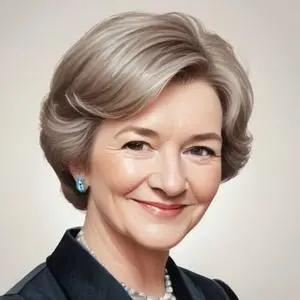
First female President of Ireland, championing human rights and climate justice globally. A trailblazing leader and advocate for social change.
Mary Robinson, the seventh President of Ireland, is renowned for her historic presidency, which marked the country's first female leader, as well as her unwavering dedication to promoting human rights globally. Throughout her illustrious career, Robinson has been a driving force behind numerous liberalizing reforms, cementing her status as a pioneering figure in Irish politics and beyond.
Born on May 21, 1944, in Ballina, County Mayo, Ireland, Mary Therese Winifred Robinson (née Bourke) was raised in a family of five children. She pursued her education at Mount Anville Secondary School and later at Trinity College Dublin, where she earned a law degree. Robinson's early career as a barrister and academic laid the foundation for her future involvement in politics.
In 1969, Robinson was elected to Seanad Éireann, the upper house of the Oireachtas (Ireland's parliament), where she served for 20 years. During this period, she became affiliated with the Labour Party, but ultimately ran as an independent candidate in the 1990 presidential election. Her historic victory marked the first time an independent candidate had been elected President of Ireland.
As President, Robinson worked tirelessly to promote liberalizing reforms, earning her widespread popularity among the Irish people. Her presidency saw significant milestones, including:
These reforms had a profound impact on Irish society, and Robinson's unwavering commitment to human rights earned her an unprecedented 93% approval rating among the electorate.
In 1997, Robinson was appointed the United Nations High Commissioner for Human Rights, a position she held until 2002. During her tenure, she visited Tibet in 1998, becoming the first High Commissioner to do so. She also criticized Ireland's immigration policy and the use of capital punishment in the United States.
After leaving the United Nations, Robinson founded Realizing Rights: The Ethical Globalization Initiative, which concluded its work in 2010. She has continued to be involved in various initiatives, serving as Chancellor of the University of Dublin and advocating for climate justice and human rights.
Mary Robinson's remarkable journey has left an indelible mark on Irish politics and the global human rights landscape. Her unwavering commitment to promoting justice, equality, and human dignity continues to inspire generations around the world.
"Climate change is a human rights issue, an economic issue, and a moral issue."
"The best way to get respect is to earn it."
"We need to recognize that human rights are not only a moral imperative, but also a sound investment in our common future."
75 Years Old
The 11th Taoiseach of Ireland, a skilled politician who played a crucial role in the Northern Ireland peace process, and oversaw a period of rapid economic growth in Ireland.
66 Years Old
The 12th Taoiseach of Ireland, serving from 2008 to 2011, led the country through a severe economic crisis and implemented austerity measures to address the situation. He's also known for his role in shaping Ireland's economy and politics.
75 Years Old
The 13th Taoiseach of Ireland, a teacher-turned-politician who led the country from 2011 to 2017, is most known for his efforts to rebuild the Irish economy after a severe financial crisis. He also played a key role in passing same-sex marriage legislation.
85 Years Old
The 9th President of Ireland is a sociologist and politician who has been a vocal advocate for human rights, social justice, and Irish culture, known for his poetic speeches and writings. He has also been a strong critic of neoliberalism and has worked to promote a more equitable society.
79 Years Old
The 10th Taoiseach of Ireland, serving from 1994 to 1997, known for leading a coalition government and playing a key role in the Northern Ireland peace process. He's a prominent figure in Irish politics and international diplomacy.
93 Years Old
The 9th Taoiseach of Ireland, a key figure in the Northern Ireland peace process, known for his role in negotiating the 1993 Downing Street Declaration. He was a prominent businessman and politician who played a crucial role in shaping Ireland's modern history.
Born in 1925
A charismatic and controversial leader who served as Ireland's prime minister, known for his role in shaping the country's economy and politics during the 1980s.
Born in 1926
The 7th Taoiseach of Ireland, a lawyer-turned-politician, led the country through significant economic and social reforms, earning him a reputation as a champion of liberalization and modernization.
