


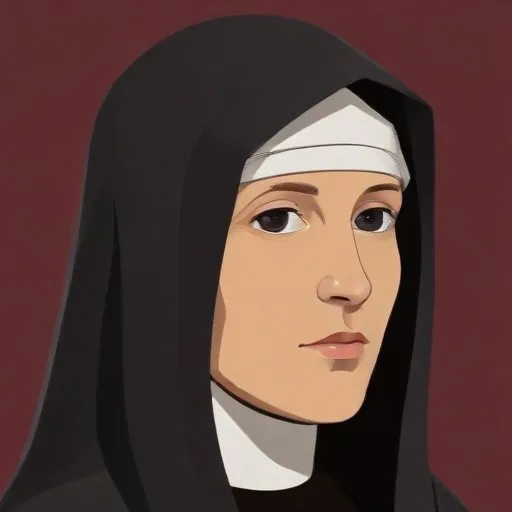
A 17th-century Spanish Franciscan abbess and mystic who wrote extensively on spirituality and theology, influencing Catholic thought and devotion. Her writings are still studied and revered today.
Mary of Jesus of Ágreda, a 17th-century Spanish nun, is renowned for her extraordinary phenomenon of bilocation, where she would simultaneously appear in two distinct locations, often separated by vast distances. Her remarkable spiritual journey, documented through her extensive correspondence with King Philip IV of Spain, has captivated hearts and minds for centuries.
Born María Coronel y de Arana on April 2, 1602, in Ágreda, Spain, Mary was the daughter of Francisco Coronel and Catalina de Arana. Growing up in a devout family, she was drawn to the teachings of the Franciscan friars, who would often visit her family home. These early interactions kindled a deep sense of spirituality within her, which would eventually blossom into remarkable mystical experiences.
Mary's most extraordinary gift was her ability to bilocate, a phenomenon that allowed her to be present in two locations simultaneously. This remarkable ability enabled her to minister to the Jumano Indians in central New Mexico and West Texas, as well as in Tucson, while remaining cloistered in her monastery in rural Spain. Her bilocation activity inspired numerous Franciscan missionaries in the New World, earning her the nickname "The Lady in Blue" or "The Blue Nun," after the color of her habit.
Mary's extensive correspondence with King Philip IV of Spain, which spanned over 22 years, has been meticulously documented. These letters provide valuable insights into her spiritual experiences, as well as her counsel to the king on matters of state and spirituality. This remarkable exchange has been hailed as one of the most significant examples of mystical communication in Catholic history.
Mary of Jesus wrote 14 books, including a series of revelations about the life of the Blessed Virgin Mary. Her literary contributions offer a glimpse into her profound spiritual understanding and her devotion to the Virgin Mary. These works have been cherished by generations of Catholics, providing inspiration and guidance to those seeking a deeper understanding of their faith.
Mary of Jesus of Ágreda's remarkable life and mystical experiences have left an indelible mark on Catholic history. Her legacy continues to inspire generations of spiritual seekers, mystics, and missionaries. Her extraordinary bilocation phenomenon has cemented her place as one of the most fascinating and enigmatic figures of the 17th century.
In conclusion, Mary of Jesus of Ágreda's extraordinary life, marked by her bilocation phenomenon, her extensive correspondence with King Philip IV, and her literary contributions, has forged an enduring legacy that continues to captivate and inspire those who seek a deeper understanding of the mystical and the divine.
Born in 1568
The 17th-century Catholic leader who reigned for 21 years, known for his strong stance against Galileo Galilei and his scientific discoveries, as well as his extensive patronage of the arts.
Born in 1611
Led the Catholic Church during a tumultuous period, reforming the Church's finances and combating corruption, while also opposing the French monarch's attempts to exert control over the Church.
Born in 1590
The 254th Pope, a strong advocate for the Catholic Church's authority, known for his papal bull condemning the doctrine of probabilism.
Born in 1675
A 18th-century pope who reformed the Catholic Church, promoting tolerance and scholarship, and is known for his encyclicals on topics like usury and the sacraments.
Born in 1504
Leader of the Catholic Church during the Counter-Reformation, he excommunicated Queen Elizabeth I and played a key role in the Council of Trent.
Born in 1499
Reigned from 1559 to 1565, this Pope oversaw the final session of the Council of Trent, shaping Catholic doctrine and practice for centuries to come. He also commissioned the construction of the Sistine Chapel's dome.
