


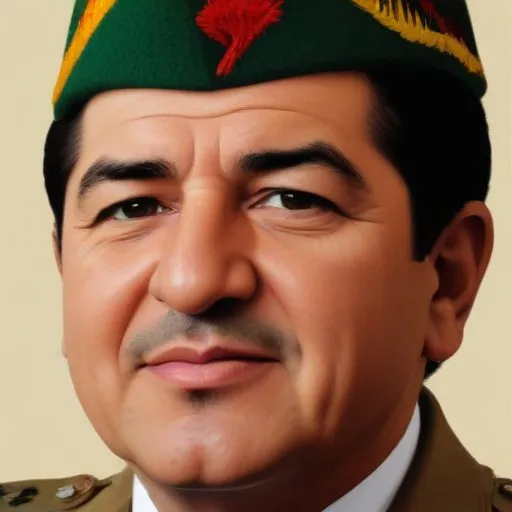
The President of Iraqi Kurdistan, a key figure in the Kurdish independence movement, known for leading the region through times of war and political turmoil. He's a unifying force for the Kurdish people, seeking autonomy and self-determination.
Known as the leader of the Kurdistan Democratic Party (KDP) since 1979 and the former President of the Kurdistan Region of Iraq from 2005 to 2017, Masoud Barzani is a household name in Kurdish politics. Born on August 16, 1946, in the territory controlled by the self-declared Republic of Mahabad, Barzani has been a force to be reckoned with in the region, fighting for Kurdish autonomy and self-determination.
Barzani succeeded his father, Mustafa Barzani, as leader of the KDP in 1979. Working closely with his brother Idris Barzani until his death, Barzani and various other Kurdish groups fought alongside the Islamic Republic of Iran against the Iraqi military during the Iran-Iraq War. This early experience shaped his stance against authoritarian regimes and his commitment to Kurdish independence.
In the aftermath of Saddam Hussein's defeat in the Gulf War (1991) and Operation Provide Comfort, Barzani played a crucial role in establishing Kurdish control over their traditional homeland in northern Iraq, known as Iraqi Kurdistan and South Kurdistan. In 1992, he was granted a Turkish passport by then-President Turgut Özal, allowing him to travel freely. This marked the beginning of a new era for the Kurdish people, with Barzani at the forefront.
In 2005, Barzani became the President of the Kurdistan Region of Iraq, a position he held until 2017. During his presidency, he oversaw significant economic growth, infrastructure development, and investment in the region. He also played a crucial role in maintaining relations with neighboring countries, including Turkey and Iran.
Throughout his career, Barzani has been driven by a deep commitment to Kurdish nationalism and self-determination. He has consistently advocated for greater autonomy for the Kurdish people, pushing against the constraints of centralized authority. His unwavering dedication to his people has earned him the respect and admiration of many.
Barzani's presidency was not without controversy. In 1994, fighting broke out between the Peshmerga of the KDP and the Patriotic Union of Kurdistan (PUK), led by Jalal Talabani. The conflict, which lasted until 1998, was eventually resolved through the Washington Peace Accords. Critics have accused Barzani of authoritarian tendencies, citing his reliance on family ties and party loyalists to consolidate power.
"We will not be silenced. We will not be oppressed. We will fight for our freedom."
Masoud Barzani's legacy is complex and multifaceted. While critics argue that he has consolidated power and undermined democratic institutions, his supporters praise his unwavering commitment to Kurdish autonomy and self-determination. As a leader, he has left an indelible mark on the Kurdistan Region of Iraq and the broader Middle East.
In conclusion, Masoud Barzani is a Kurdish politician who has defied authority and fought for his people's rights. His unwavering commitment to Kurdish nationalism and self-determination has earned him a place in history as a champion of freedom and autonomy.
89 Years Old
The authoritarian leader who ruled Iraq with an iron fist, notorious for his brutal suppression of dissent and invasion of neighboring countries.
75 Years Old
The 11th President of Turkey, a politician and academic who played a key role in shaping Turkey's modern politics and foreign policy, known for his efforts to strengthen Turkey's ties with the EU.
