


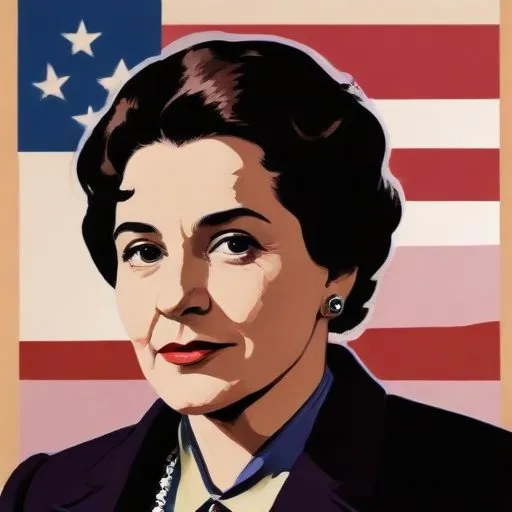
Pioneering social reformer and writer who advocated for women's rights, education, and world peace through her literary works and activism.
Maud Howe Elliott, an American novelist, is best known for her Pulitzer Prize-winning collaboration with her sisters, Laura E. Richards and Florence Hall, on their mother's biography, The Life of Julia Ward Howe (1916). This monumental work cemented her place in literary history, but her contributions to society extend far beyond this remarkable achievement.
Born on November 9, 1854, at the Perkins School for the Blind in Boston, Maud was the daughter of Samuel Gridley Howe, the school's founder, and Julia Ward Howe, a prominent author and abolitionist. Growing up in a family deeply committed to social justice and education, Maud's early life was shaped by her mother's strong convictions and her father's dedication to helping the visually impaired.
Maud's writing career spanned multiple decades, during which she published numerous novels, travelogues, and biographies. Some of her notable works include A Newport Aquarelle (1883), Phillida (1891), Mammon (later published as Honor: A Novel in 1893), Roma Beata, Letters from the Eternal City (1903), and Sun and Shadow in Spain (1908). Her writing often explored themes of social justice, women's rights, and the human experience.
In 1887, Maud married English artist John Elliott, and the couple lived in Chicago, Italy, and eventually settled in Newport, Rhode Island. Maud was a founding member of the Society of the Four Arts in Palm Beach, Florida, and served as its honorary president until her death. She was also a dedicated suffragist, influenced by her mother's convictions, and played an active role in the women's suffrage movement.
In 1920, Maud faced a significant setback when a Congressional Act revoked her citizenship due to her marriage to a foreign national. This discriminatory legislation targeted American-born women who married foreigners, stripping them of their citizenship rights, while men in similar situations retained their citizenship.
Maud Howe Elliott's legacy extends beyond her literary achievements to her tireless advocacy for women's suffrage and social justice. Her life's work serves as a testament to the power of dedication, perseverance, and conviction. As a pioneering novelist and suffragist, Maud Howe Elliott continues to inspire generations of women and writers alike.
Maud Howe Elliott's remarkable life and achievements are a testament to her unwavering commitment to social justice, women's rights, and literary excellence. Her legacy continues to inspire and educate, serving as a beacon of hope for generations to come.
Born in 1819
Pioneering poet and songwriter credited with writing the "Battle Hymn of the Republic", a powerful anthem that became a rallying cry for the Union during the American Civil War.
Born in 1801
Pioneering physician and advocate for the blind, he founded the Perkins School for the Blind and developed the first Braille alphabet in the United States.
Born in 1820
Pioneering nurse and statistician who revolutionized healthcare by introducing sanitation practices and data-driven decision making, becoming the founder of modern nursing.
Born in 1821
Founded the American Red Cross, providing humanitarian aid and disaster relief, and pioneering nursing education. Known for her courageous and selfless efforts during the Civil War and beyond.
Born in 1820
Pioneering figure in the women's suffrage movement, fighting for women's right to vote and own property. Her tireless efforts led to significant advancements in women's rights.
Born in 1815
Pioneering women's rights activist who led the women's suffrage movement, fighting for women's right to vote and own property.
Born in 1793
A pioneering Quaker minister and women's rights activist who fought for abolition and women's suffrage, playing a key role in the Seneca Falls Convention.
