


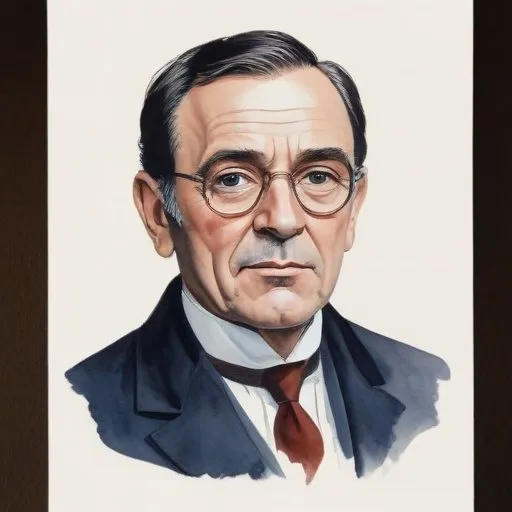
French author and screenwriter behind the acclaimed historical novel series "The Accursed Kings", which was adapted into a popular TV miniseries. He's also known for his work on the French Resistance during WWII.
Maurice Druon, a French novelist, and member of the prestigious Académie Française, is renowned for his contributions to literature and his influential role as Perpetual Secretary of the Académie Française from 1985 to 1999. His literary works, particularly his novel "Les Grandes Familles," earned him the esteemed Prix Goncourt in 1948.
Born on April 23, 1918, in Paris, France, Druon was the son of Russian-Jewish immigrant Lazare Kessel. After his father's suicide in 1920, Druon's mother remarried, and he took the name of his adoptive father, René Druon. He was educated at the Lycée Michelet de Vanves and began writing for literary journals at the tender age of 18.
In 1939, Druon wrote an article for Paris-Soir, "J'ai vingt ans et je pars" (I am twenty years old and I am leaving), which marked the beginning of his literary career. During World War II, he joined the French Resistance and collaborated with his uncle, Joseph Kessel, to translate the iconic "Chant des Partisans," a French Resistance anthem. In 1942, his first play, "Mégare," was produced in Monte Carlo.
Druon's novel "Les Grandes Familles" (The Great Families) earned him the Prix Goncourt in 1948. He went on to publish two sequels, solidifying his reputation as a prominent French novelist. In 1966, he was elected to the Académie Française, a prestigious institution dedicated to promoting French language and literature.
In 1985, Druon was appointed Perpetual Secretary of the Académie Française, a position he held until 1999. During his tenure, he championed the cause of women's inclusion in the institution and played a crucial role in electing Hélène Carrère d'Encausse as the first female Perpetual Secretary in 1999.
Druon's life was marked by personal milestones, including his marriage to Madeleine Marignac and his later years, during which he continued to write and participate in literary circles. He passed away on April 14, 2009, leaving behind a legacy as one of France's most celebrated literary figures.
"L'écrivain est un être qui vit dans l'instant, mais qui est coupé du reste du monde" (The writer is a being who lives in the moment, but is cut off from the rest of the world).
Born in 1910
A renowned French playwright and screenwriter, known for his poignant and thought-provoking works that often explored the human condition, morality, and the absurdity of life.
Born in 1900
A pioneering aviator and writer, known for his poetic and philosophical novels, particularly "The Little Prince", which has become a timeless classic of world literature.
Born in 1901
A French historian, theorist, and author who wrote influential novels and essays on art, politics, and human condition, exploring the complexities of modern society.
Born in 1905
Existentialist philosopher and playwright who argued that humans have complete freedom to choose their actions and create their own meaning in life, influencing modern thought on morality and individual responsibility.
Born in 1908
A pioneering feminist philosopher who wrote extensively on ethics, politics, and gender, famously arguing that "one is not born, but rather becomes, a woman."
91 Years Old
A celebrated French literary figure, known for her provocative and introspective works that explored the human condition, particularly among the young and disillusioned. Her writing often blended wit, sophistication, and emotional depth.
Born in 1913
A French novelist, philosopher, and journalist who wrote influential works like "The Stranger" and "The Plague", exploring absurdism and the human condition.
Born in 1914
A French Renaissance man who excelled in multiple fields, including literature, diplomacy, filmmaking, and aviation, leaving a lasting impact on 20th-century culture.
