


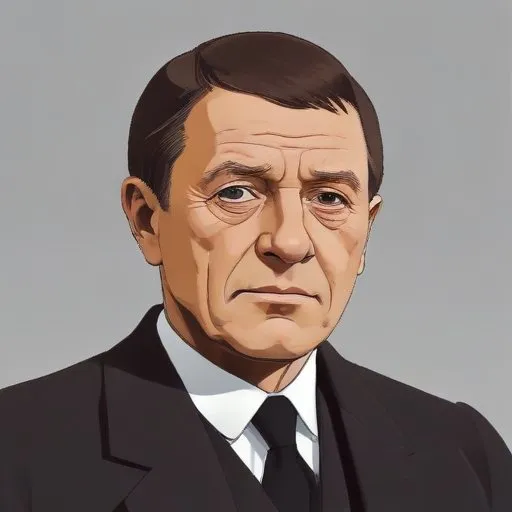
A renowned British historian and academic who specialized in modern European history, particularly the Russian Revolution and the Soviet Union. He was a prominent figure in British academic circles and served as the Vice-Chancellor of the University of Oxford.
Max Beloff, Baron Beloff, was a British historian and Conservative peer who made significant contributions to the field of history and politics. He is best known for his work as the principal of the University College of Buckingham, now the University of Buckingham, from 1974 to 1979.
Beloff was born on July 2, 1913, in London, to a Jewish family who had migrated from Russia in 1903. He was the oldest of five children, and his siblings went on to achieve notable success in their respective fields. Beloff's education at St Paul's School and Corpus Christi College, Oxford, laid the foundation for his future academic pursuits. He graduated with first-class honors in Modern History and was later awarded a Scholar MA and Honorary Fellow in 1993.
In his autobiographical work, "A Historian in the Twentieth Century" (1992), Beloff reflected on his political journey, which saw him transition from a conservative to a socialist and eventually a liberal after World War II. He was a vocal advocate for thoughtful political discourse, arguing that a referendum is only meaningful if clear alternatives are presented to the electorate.
Beloff's academic career was marked by significant contributions to the field of history. He authored several notable works, including "The Age of Absolutism" (1954) and "Public Opinion and Popular Government" (1956). His scholarly works showcased his expertise in modern history, particularly in the areas of politics, philosophy, and international relations.
Beloff's contributions to academia and politics were recognized with several awards and honors. He was appointed a life peer in 1981, taking the title Baron Beloff of Wolvercote. In addition, he was elected a Fellow of the British Academy in 1971.
Beloff's personal life was marked by significant milestones, including his marriage to Helen Margaret Rowe in 1941. He was also known for his close relationships with his siblings, including his sister Nora Beloff, a journalist and political correspondent, and his brother John Beloff, a psychologist.
Beloff's work had a profound impact on modern society, shaping the way historians and politicians approached complex issues. His advocacy for thoughtful political discourse and his commitment to academic excellence continue to inspire future generations of scholars and leaders.
Max Beloff, Baron Beloff, left an indelible mark on the world of history and politics. His groundbreaking work, philosophical contributions, and commitment to academic excellence continue to influence modern society. As a pioneering historian and Conservative peer, Beloff's legacy serves as a testament to the power of intellectual curiosity and dedication to public service.
Born in 1909
A Latvian-English historian and philosopher who explored the intersection of philosophy, history, and politics, and is renowned for his work on the Enlightenment, liberty, and the nature of humanity.
Born in 1914
A renowned historian and academic who wrote extensively on European history, particularly the Renaissance and Nazi Germany, and was known for his meticulous research and engaging writing style.
Born in 1906
A renowned historian and academic who reshaped the understanding of modern European history, particularly World War I and II, through provocative and insightful writings.
Born in 1889
A British historian who developed the theory of civilizations rising and falling in a predictable cycle, and wrote a 12-volume magnum opus on world history.
Born in 1903
A renowned writer of dystopian classics, such as "1984" and "Animal Farm", who warned of totalitarianism's dangers through allegorical fiction.
