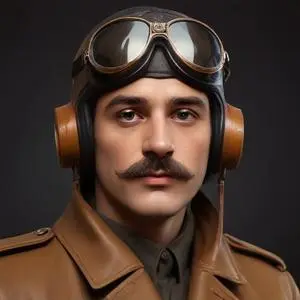
Max Immelmann: The Ace of Aces and Pioneer of Fighter Aviation
Aerial Supremacy and the Birth of Modern Dogfighting
Max Immelmann is renowned as the first German World War I flying ace, credited with 15 aerial victories and pioneering the art of fighter aviation. His name has become synonymous with aerial supremacy, and his legendary Immelmann turn remains a staple of dogfighting tactics to this day.
Early Life and Military Career
Born on September 21, 1890, in Dresden, Germany, Immelmann's life was marked by tragedy when his industrialist father died during his youth. Enrolled in the Dresden Cadet School in 1905, Immelmann's military career began in earnest when he joined the Eisenbahnregiment Railway Regiment Nr. 2 in 1911 as an Ensign. However, he left the army in 1912 to pursue studies in mechanical engineering, only to return to service at the outbreak of World War I in 1914.
Rise to Aerial Supremacy
Immelmann's transformation into a flying ace began when he was called to active service and transferred to the German Army's air arm, Die Fliegertruppe des Deutschen Kaiserreiches. Sent for pilot training at Johannisthal Air Field in November 1914, Immelmann's skills quickly distinguished him from his peers. Initially stationed in northern France, he served with Feldflieger Abteilung Field Flier Detachment 10 from February to April 1915 and later with FFA 62.
Aerial Victories and the Pour le Mérite
Immelmann's first aerial victory occurred on June 1, 1915, when he shot down a French aircraft. This achievement earned him the Pour le Mérite, colloquially known as the Blue Max, which he received alongside
Oswald Boelcke. This prestigious honor marked a turning point in Immelmann's career, cementing his reputation as a master of the skies.
Innovator and Pioneer
Immelmann's innovative tactics and aerial prowess led to the development of the Immelmann turn, a maneuver that allows pilots to change direction rapidly while maintaining speed and momentum. This tactical innovation has been adopted by air forces around the world and remains an essential component of modern dogfighting.
Legacy and Impact
Max Immelmann's remarkable career was cut short when he was killed in action on June 18, 1916. Nevertheless, his legacy continues to inspire generations of pilots and air forces. His innovative spirit, aerial supremacy, and contributions to modern fighter aviation have earned him a place in the annals of history as one of the greatest flying aces of all time.
Trivia and Fun Facts
- Immelmann was initially shot down by a French pilot on June 3, 1915, but managed to land safely behind German lines.
- He was decorated with the Iron Cross, Second Class, for preserving his aircraft during the June 3 incident.
- Immelmann's name has become synonymous with aerial excellence, with the term "Immelmann" used to describe exceptional flying skills.
Max Immelmann's remarkable life and career serve as a testament to his unwavering dedication, innovative spirit, and unrelenting passion for flight. As a pioneer of fighter aviation, his legacy continues to inspire and influence the world of aerial combat.
FAQ
What was Max Immelmanns role in World War I?
Max Immelmann was a German lieutenant and pilot who served in World War I, earning the Pour le Mérite, Germanys highest military honor, for his bravery and exceptional flying skills.
What was Max Immelmanns contribution to German aviation?
Max Immelmann was one of the first German fighter pilots, helping to develop the concept of air combat and establishing himself as one of the earliest flying aces.
What was Max Immelmanns aircraft like?
Max Immelmann flew a Fokker Eindecker, a pioneering monoplane fighter aircraft that gave him a significant advantage over his enemies.
What was Max Immelmanns most famous exploit?
Max Immelmanns most famous exploit was his defeat of eight British aircraft in a single engagement, earning him the nickname The Blue Max and cementing his reputation as a legendary fighter pilot.
What legacy did Max Immelmann leave behind?
Max Immelmanns legacy extends beyond his military achievements, as he helped shape the development of air combat and inspired generations of pilots to follow in his footsteps.