


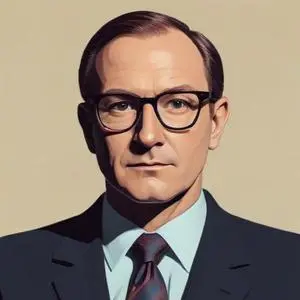
Served as a key advisor to Presidents John F. Kennedy and Lyndon B. Johnson, playing a crucial role in shaping US foreign policy during the Cold War era, particularly in regards to the Vietnam War.
McGeorge Bundy, a prominent American academic, is best remembered as the chief architect of the United States' escalation of the Vietnam War during the Kennedy and Johnson administrations. As the U.S. National Security Advisor to Presidents John F. Kennedy and Lyndon B. Johnson from 1961 through 1966, Bundy played a pivotal role in shaping the country's foreign policy, with far-reaching consequences.
Born on March 30, 1919, in Boston, Massachusetts, Bundy was the third son of a prosperous family deeply involved in Republican politics. His father, Harvey Hollister Bundy, was a prominent attorney, and his mother, Katherine Lawrence Putnam, was related to several Boston Brahmin families listed in the Social Register.
After serving as an intelligence officer in World War II, Bundy's career in foreign policy took off. In 1949, he was selected for the Council on Foreign Relations, where he worked on the implementation of the Marshall Plan.
In 1953, Bundy became the youngest dean of the Faculty of Arts and Sciences at Harvard University, where he worked to develop the institution as a merit-based university.
Bundy's most significant and controversial role was as the U.S. National Security Advisor to Presidents Kennedy and Johnson. During this time, he was instrumental in escalating the United States' involvement in the Vietnam War.
After leaving the White House in 1966, Bundy became the president of the Ford Foundation, a position he held until 1979.
In 1979, he returned to academia, becoming a professor of history at New York University and later a scholar in residence at the Carnegie Corporation.
Despite his many accomplishments, Bundy's legacy is largely defined by his role in the Vietnam War. His hawkish stance and influence on the administration's foreign policy decisions have been widely criticized.
Love him or loathe him, McGeorge Bundy's impact on American history is undeniable. His story serves as a reminder of the importance of understanding the complexities of foreign policy and the need for critical thinking in times of crisis.
Born in 1923
A renowned diplomat and strategist who played a pivotal role in shaping global politics during the Cold War era, known for his Realpolitik approach and brokering peace agreements .
Born in 1916
The 8th United States Secretary of Defense played a crucial role in shaping US foreign policy during the Cold War era, particularly in the Vietnam War. He is infamous for his controversial decisions and legacy.
Born in 1908
The 36th President of the United States, a skilled politician and leader, played a crucial role in passing landmark civil rights legislation, including the Civil Rights Act and Voting Rights Act.
Born in 1917
The 35th President of the United States was a charismatic leader who navigated the country through the Cuban Missile Crisis and advocated for civil rights, leaving a lasting legacy in American politics.
Born in 1913
The 37th President of the United States, a polarizing figure who led the country through significant domestic and foreign policy changes, infamous for his involvement in the Watergate scandal.
Born in 1913
The 38th President of the United States, a former football star and lawyer, is known for being the first vice president to assume the presidency under the 25th Amendment and for his controversial pardon of Richard Nixon. He's also remembered for his humble and accidental rise to the presidency.
Born in 1924
A naval officer turned politician who served as the 39th President of the United States, known for his commitment to human rights and social justice, and awarded the Nobel Peace Prize in 2002.
98 Years Old
A Polish-born American strategist and policymaker who served as National Security Advisor, shaping US foreign policy and advising presidents on global affairs. Known for his realist approach and expertise on geopolitics.
