


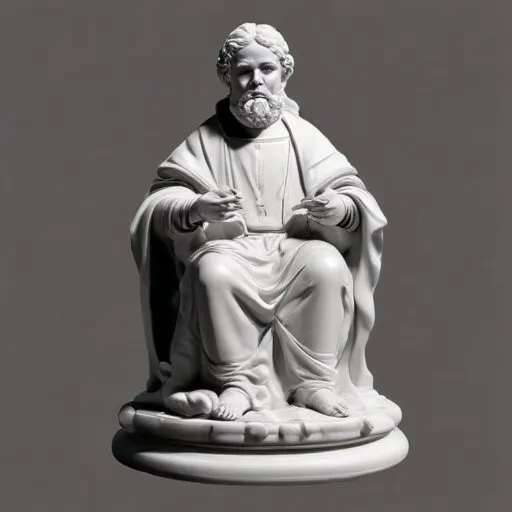
A 17th-century Maltese Baroque sculptor, renowned for his ornate and intricate stone carvings that adorned Malta's grandest buildings, including St. John's Co-Cathedral in Valletta.
Melchiorre Caf, also known as Caff, Gafa, Gaffar, or Gafar, was a renowned Maltese Baroque sculptor who made significant contributions to the world of art during his short but productive life. He is best known for his stunning sculptures that adorned churches and cathedrals in Malta and Rome, showcasing his exceptional skill and attention to detail.
Born in Vittoriosa, Malta, on January 21, 1636, Melchiorre Caf was baptized as Marcello. He later adopted the name Melchior or Melchiorre Maltese after moving to Rome in 1658. His brother, Lorenzo Gaf, was a prominent architect in Malta, and the two siblings shared a passion for art and architecture.
Caf refined his sculpting skills under the guidance of Ercole Ferrata, a prominent sculptor in Rome. Although Ferrata was not his formal teacher, Caf's work was heavily influenced by his mentor's style. He soon attracted his own commissions and collaborated with Ferrata on several projects.
One of Caf's earliest and most notable works is the relief of the Martyrdom of Saint Eustace in Sant'Agnese in Agone, Rome. He signed the contract for this work in 1660 with Prince Camillo Pamphilj. This commission marked the beginning of his successful career as an independent sculptor.
In 1662, Caf became a member of the prestigious Accademia di San Luca, and in 1667, he was elected as its principal. However, he declined the honor, showcasing his humility and dedication to his craft.
Tragically, Melchiorre Caf's life was cut short when he died on September 4, 1667, at the age of 31. He was working on the altar decoration for St. John's Co-Cathedral in Valletta, Malta, when a material collapse in the foundry caused his untimely death.
Despite his short life, Caf's contributions to the world of art are undeniable. His sculptures continue to inspire and awe art lovers to this day. The Maltese Post Office has honored his memory by issuing stamps featuring his works.
Today, Melchiorre Caf is remembered as one of the most talented and influential Baroque sculptors of his time, leaving behind a legacy that continues to inspire and influence generations of artists and art enthusiasts.
Born in 1598
A renowned Baroque master who crafted exquisite sculptures and paintings that captivated 17th-century Rome, leaving an indelible mark on the art world.
Born in 1598
A renowned Baroque sculptor, famous for his intricate and emotionally charged marble works, particularly his dramatic high-relief sculptures that capture the essence of ancient Greek and Roman art.
Born in 1597
A Flemish sculptor and educator who created intricate and emotive works, particularly in marble, and taught many prominent artists of his time.
Born in 1596
A prominent Baroque painter who created elaborate, dramatic, and emotive works that adorned the ceilings of Roman palaces and churches, influencing the development of 17th-century art.
Born in 1599
A 17th-century painter who revolutionized Roman Baroque art with his innovative use of color and composition, creating dramatic and emotive works that captivated the art world.
Born in 1581
A prominent painter of the Baroque period, known for his vivid and emotive depictions of mythological and biblical scenes, which greatly influenced the development of 17th-century art.
Born in 1575
A prominent Baroque painter and illustrator, renowned for his vivid and emotive depictions of mythological and religious scenes. His works are celebrated for their dramatic lighting and intense emotional power.
