


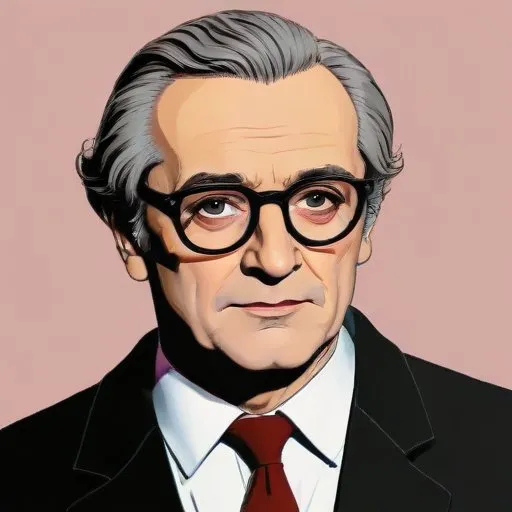
A French literary critic and theorist who developed influential theories on semiotics, structuralism, and reader-response criticism, particularly in the context of poetry and narrative.
Michael Riffaterre, a French literary critic and theorist, is renowned for his groundbreaking work in the field of literary theory, particularly his concept of intertextuality. His book, Semiotics of Poetry, is a seminal work that has had a profound impact on the way we approach literary analysis.
Born on November 20, 1924, in Bourganeuf, Creuse, France, Riffaterre's life was shaped by the tumultuous years of World War II. He fought in the French Resistance, an experience that would later inform his intellectual pursuits.
After the war, Riffaterre enrolled at the University of Lyon, where he excelled in French literature, winning the prestigious concours général prize. He later earned his M.A. in classics from the Sorbonne in 1947.
Riffaterre's magnum opus, Semiotics of Poetry, marked a significant shift in literary theory. In it, he introduced the concept of intertextuality, which posits that a text's meaning is inherently connected to other texts. This idea revolutionized the way scholars approach literary analysis, as it recognizes that a text's significance is not isolated, but rather, it is part of a larger web of textual relationships.
Riffaterre's concept of intertextuality is not simply about recognizing allusions or references to other texts. Rather, it is a method of textual decoding that acknowledges the reader's role in creating meaning. Intertextuality, in this sense, is not a secondary or supplementary aspect of literary analysis, but an essential component of it.
Michael Riffaterre's work has had a profound impact on literary theory and criticism. His concept of intertextuality has influenced scholars across disciplines, from literary studies to cultural theory. His legacy continues to shape the way we approach literary analysis, ensuring that his work remains an essential part of academic discourse.
"Intertextuality is not a felicitous surplus, the privilege of a good memory or a classical education. The term indeed refers to an operation of the reader's mind, but it is an obligatory one, necessary to any textual decoding."
Michael Riffaterre's life was marked by a commitment to scholarship and intellectual inquiry. He passed away on May 27, 2006, in New York, leaving behind a legacy of profound scholarship and a redefined understanding of literary analysis.
Born in 1915
A French philosopher, theorist, and critic who challenged traditional notions of culture, literature, and identity through his influential writings on semiotics, mythology, and structuralism. He's most known for his critical theories on modern society and culture.
Born in 1926
A French historian and philosopher who critiqued power structures and social norms, arguing that knowledge and truth are shaped by those in power. He's known for his concepts of power, discipline, and surveillance.
96 Years Old
A pioneer of poststructuralism, deconstructing traditional notions of meaning and challenging Western philosophy's core assumptions. His work redefined the way we think about language, culture, and identity.
Born in 1905
Existentialist philosopher and playwright who argued that humans have complete freedom to choose their actions and create their own meaning in life, influencing modern thought on morality and individual responsibility.
Born in 1908
A pioneering feminist philosopher who wrote extensively on ethics, politics, and gender, famously arguing that "one is not born, but rather becomes, a woman."
Born in 1913
A French novelist, philosopher, and journalist who wrote influential works like "The Stranger" and "The Plague", exploring absurdism and the human condition.
Born in 1918
A prominent 20th-century philosopher who developed the concept of "ideological state apparatuses" and reinterpreted Marxism, influencing modern social and political thought.
Born in 1925
A French philosopher who developed influential concepts like "rhizome" and "desire-machines," which challenged traditional notions of identity, reality, and power.
