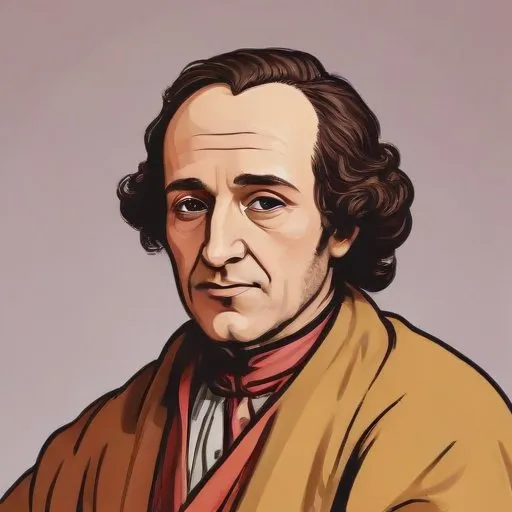
Moses Mendelssohn

Moses Mendelssohn

Moses Mendelssohn was born on September 6th, 1729

Full Name: Moses Mendelssohn
Birth Date: September 6, 1729
Place of Birth: Dessau, Germany
Occupation: Philosopher Theologian
Nationality: German
Known For: Enlightenment philosopher
Religious Affiliation: Judaism
Spouse: Fromet Gugenheim

A leading figure of the Haskalah, the Jewish Enlightenment, who sought to reconcile traditional Judaism with modern European philosophy and culture. He's known for his efforts to integrate Jews into European society.

Timeline
1729
Born in Dessau, Germany
Moses Mendelssohn was born in 1729 in Dessau, Germany. He would go on to become a prominent philosopher and theologian.
1743
Moves to Berlin
Mendelssohn moved to Berlin, where he would establish himself as a leading figure in Jewish intellectual circles.
1763
Publishes Phädon
Mendelssohn published his philosophical treatise Phädon, which explored the nature of morality and virtue.
1783
Publishes Jerusalem
Mendelssohn published his influential work Jerusalem, which argued for the separation of church and state.
1786
Dies in Berlin, Germany
Mendelssohn died in 1786 in Berlin, Germany, leaving behind a legacy as a pioneering Jewish philosopher and theologian.
Moses Mendelssohn

Moses Mendelssohn Quiz

Moses Mendelssohn's efforts were focused on integrating Jews into which society?

Score: 0/5
FAQ
What were Moses Mendelssohns key philosophical contributions?
Moses Mendelssohn was a key figure in the German Enlightenment, and his philosophical contributions focused on the relationship between reason and faith, the nature of God, and the role of education in human development.
How did Moses Mendelssohns Jewish heritage influence his philosophy?
Moses Mendelssohns Jewish heritage had a profound impact on his philosophy, as he sought to reconcile Jewish tradition with Enlightenment values. He argued that Judaism was compatible with reason and that the pursuit of knowledge was a fundamental aspect of Jewish identity.
What was Moses Mendelssohns role in the Haskalah movement?
Moses Mendelssohn was a key figure in the Haskalah movement, a Jewish Enlightenment movement that sought to promote education, cultural integration, and social reform among European Jews.
How did Moses Mendelssohns teachings influence the development of modern Judaism?
Moses Mendelssohns teachings had a significant impact on the development of modern Judaism, as he helped to pave the way for the development of Reform Judaism and the integration of Jewish values with Enlightenment principles.
What was Moses Mendelssohns relationship like with Immanuel Kant?
Moses Mendelssohn and Immanuel Kant had a complex and respectful relationship, as they engaged in a series of philosophical debates and exchanges that shaped the development of German philosophy in the 18th century.

Related People:

Immanuel Kant

Born in 1724

Developed influential philosophical frameworks, such as the Critique of Pure Reason, that shaped modern Western thought on ethics, morality, and human understanding.

Gotthold Ephraim Lessing

Born in 1729

A prominent Enlightenment thinker, he's known for his influential writings on philosophy, literature, and theology, which helped shape modern German culture. He's also credited with developing the concept of dramatic irony in literature.

Baruch Spinoza

Born in 1632

A 17th-century philosopher and scholar who developed a comprehensive philosophical system that emphasizes God, nature, and human freedom, influencing modern thought on ethics, politics, and religion.

David Hume

Born in 1711

A Scottish Enlightenment thinker who developed influential ideas on morality, ethics, and human nature, and is considered one of the most important figures in the history of Western philosophy.

Jean-Jacques Rousseau

Born in 1712

A pioneering thinker who shaped modern democracy and education with his ideas on social contracts, general will, and the importance of early childhood education. His writings influenced the French Revolution and modern political thought.

Voltaire

Born in 1694

A witty and insightful 18th-century writer and philosopher who used satire to critique societal norms and advocate for reason, tolerance, and human rights.

John Locke

Born in 1632

A 17th-century thinker who laid the groundwork for modern democracy, arguing that governments derive their power from the people and that individuals have inherent rights to life, liberty, and property.

René Descartes

Born in 1596

Developed influential philosophical and mathematical concepts, including the famous phrase "I think, therefore I am," and laid the foundation for modern Western philosophy.