


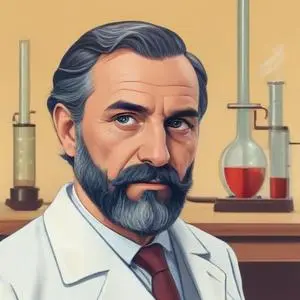
Developed a method for hydrogenating organic compounds, earning a Nobel Prize in Chemistry in 1912 for his groundbreaking work in catalysis. His discoveries paved the way for the production of margarine, synthetic rubber, and other essential materials.
Paul Sabatier, a French chemist, is renowned for his groundbreaking work on the hydrogenation of organic species in the presence of metals, earning him the Nobel Prize in Chemistry in 1912, alongside Victor Grignard. His pioneering research paved the way for the development of modern industrial processes, transforming the field of chemistry forever.
Born on November 5, 1854, in Carcassonne, France, Sabatier's fascination with science was nurtured from a young age. He pursued his passion at the prestigious Ecole Normale Supérieure, where he graduated at the top of his class in 1877. Following his graduation, Sabatier earned a Doctor of Science degree from the College de France in 1880.
Sabatier's most significant collaboration was with Jean-Baptiste Senderens, which spanned over two decades. Together, they co-authored 34 notes in the Accounts of the Academy of Science, 11 memoirs in the Bulletin of the French Chemical Society, and two joint memoirs to the Annals of Chemistry and Physics. Their partnership led to the discovery of the Sabatier-Senderens Process, a groundbreaking method for the hydrogenation of organic compounds.
In 1902, Sabatier and Senderens discovered the methanation reactions of COx, a finding that would have far-reaching implications for the chemical industry. Their work earned them the Academy of Sciences Jecker Prize in 1905, further solidifying their reputation as pioneers in the field.
Sabatier's contributions to chemistry are still felt today. He greatly facilitated the industrial use of hydrogenation, enabling the mass production of chemicals and fuels. His research on partition coefficients, absorption spectra, and the oxides of nitrogen has had a lasting impact on the field.
In addition to his scientific achievements, Sabatier was an esteemed educator, teaching science classes for most of his life. He served as the Dean of the Faculty of Science at the University of Toulouse from 1905 until his retirement.
Sabatier's dedication to his work was matched only by his humility. He remained committed to his research and teaching, shunning the limelight and focusing on the betterment of humanity through science. His legacy serves as a testament to the power of collaboration, perseverance, and innovation.
Paul Sabatier's remarkable journey came to an end on August 14, 1941, but his contributions to chemistry will continue to inspire generations to come.
Born in 1871
A French chemist and academic who developed the Grignard reaction, a crucial process in organic chemistry that enables the formation of carbon-carbon bonds, revolutionizing the field.
Born in 1852
Discovered the element fluorine and developed an electric arc furnace, earning a Nobel Prize in Chemistry in 1906.
Born in 1867
A pioneering scientist who pioneered radioactivity research, discovering elements polonium and radium, and paving the way for breakthroughs in medicine and energy.
Born in 1859
A pioneer in radioactivity research, discovering elements like polonium and radium, and pioneering radioactive isolation techniques. Their groundbreaking work paved the way for advancements in medicine, energy, and materials science.
Born in 1870
A Nobel Prize-winning physicist and chemist who pioneered the study of the atom, providing conclusive evidence for its existence and structure. Their work laid the foundation for modern particle physics.
Born in 1900
A Nobel Prize-winning physicist who pioneered radioactivity research and discovered artificial radioactivity, leading to breakthroughs in medicine and industry.
Born in 1892
A French physicist and Nobel laureate who proposed that particles, such as electrons, can exhibit wave-like behavior, revolutionizing quantum mechanics. His hypothesis led to major breakthroughs in understanding the atomic structure.
Born in 1871
A pioneer in nuclear physics, he discovered the nucleus of an atom and developed the Rutherford model, revolutionizing our understanding of the atomic structure.
