


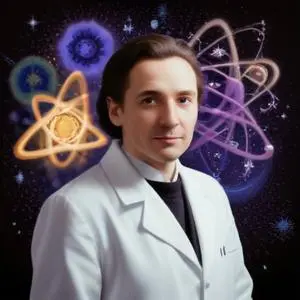
A Nobel Prize-winning physicist who pioneered radioactivity research and discovered artificial radioactivity, leading to breakthroughs in medicine and industry.
Frdric Joliot-Curie is renowned for his groundbreaking discovery of induced radioactivity, a feat that earned him the Nobel Prize in Chemistry in 1935 alongside his wife, Irne Joliot-Curie. This pioneering achievement revolutionized the field of nuclear physics, paving the way for significant advancements in our understanding of the atomic structure.
Born on March 19, 1900, in Paris, France, Frdric Joliot-Curie was a graduate of the prestigious ESPCI Paris. His academic trajectory took a significant turn in 1925 when he became an assistant to the legendary Marie Curie at the Radium Institute. It was during this period that he fell in love with Marie's daughter, Irne Curie, and they eventually married in 1926, adopting the surname Joliot-Curie.
Frdric Joliot-Curie's research career was deeply intertwined with his wife's, and together they formed an unstoppable team. As a lecturer at the Paris Faculty of Science, he collaborated with Irne on the structure of the atom, focusing on the recoil of nuclei struck by particles. This research laid the foundation for James Chadwick's discovery of the neutron in 1932.
In 1935, Frdric and Irne Joliot-Curie were awarded the Nobel Prize in Chemistry for their groundbreaking discovery of induced radioactivity. By bombarding stable elements like boron, magnesium, and aluminum with alpha particles, they successfully created short-lived radioisotopes through nuclear transmutation. This breakthrough had far-reaching implications for nuclear physics, medicine, and industry.
In 1937, Frdric Joliot-Curie left the Radium Institute to become a professor at the Collge de France. During this period, he remained committed to his research and was vocal about the potential consequences of nuclear fission. In 1939, he alerted his Soviet colleague Abram Ioffe to the German discovery of nuclear fission, highlighting its immense energy potential.
Frdric Joliot-Curie's contributions to science have had a lasting impact on modern society. His work on induced radioactivity paved the way for significant advancements in medicine, energy production, and our understanding of the atomic structure. Today, he is remembered as a trailblazing physicist who expanded the boundaries of human knowledge.
Frdric Joliot-Curie's remarkable life and achievements serve as a testament to the power of human ingenuity and collaboration. His groundbreaking discovery of induced radioactivity has left an indelible mark on the scientific community, inspiring generations of physicists and researchers to continue pushing the boundaries of human knowledge.
Born in 1867
A pioneering scientist who pioneered radioactivity research, discovering elements polonium and radium, and paving the way for breakthroughs in medicine and energy.
Born in 1859
A pioneer in radioactivity research, discovering elements like polonium and radium, and pioneering radioactive isolation techniques. Their groundbreaking work paved the way for advancements in medicine, energy, and materials science.
Born in 1897
A pioneering scientist who pioneered radioactivity research and discovered elements, earning a Nobel Prize in Chemistry in 1935. Her groundbreaking work paved the way for advancements in nuclear physics and medicine.
Born in 1900
A Nobel Prize-winning physicist who pioneered radioactivity research and discovered artificial radioactivity, leading to breakthroughs in medicine and industry.
Born in 1879
A brilliant physicist who developed the theory of relativity and is considered one of the most influential scientists of the 20th century, known for his groundbreaking work in physics and mathematics.
Born in 1885
A pioneer in quantum mechanics, he introduced the concept of wave-particle duality, revolutionizing our understanding of atomic structure. His philosophical approach to science also explored the nature of reality and human understanding.
Born in 1901
A pioneer in quantum mechanics, he formulated the uncertainty principle, which revolutionized our understanding of the atomic world. His groundbreaking work reshaped modern physics.
Born in 1901
A pioneer in nuclear physics, known for leading the team that developed the first nuclear reactor and playing a crucial role in the development of the atomic bomb.
