


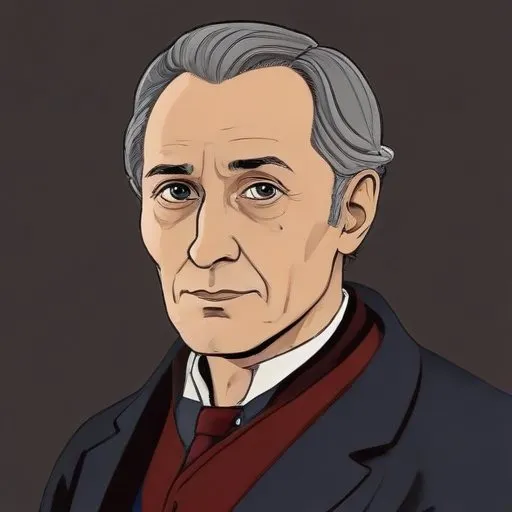
A pioneer in Soviet physics, known for his groundbreaking work in semiconductor research and development of the first Soviet nuclear reactor.
Abram Fedorovich Ioffe, a prominent Soviet physicist, left an indelible mark on the scientific community with his groundbreaking contributions to solid state physics, electromagnetism, and nuclear physics. His pioneering work in these fields earned him numerous accolades, including the Stalin Prize, Lenin Prize, and the Hero of Socialist Labor award.
Ioffe was born on October 29, 1880, in Romny, Russian Empire (now in Ukraine), to a middle-class Ukrainian Jewish family. He graduated from the Saint Petersburg State Institute of Technology in 1902 and later spent two years as an assistant to Wilhelm Röntgen in his Munich laboratory. Ioffe completed his Ph.D. at Munich University in 1905, where his dissertation focused on the electrical conductivity of dielectric crystals under electrical stress.
Ioffe's return to Saint Petersburg (later Leningrad) in 1906 marked the beginning of his illustrious career. He became a professor at the Leningrad Polytechnical Institute and established research laboratories for radioactivity, superconductivity, and nuclear physics. These laboratories eventually grew into independent institutes, cementing Ioffe's reputation as a visionary scientist.
In 1911, Ioffe independently determined the charge of an electron, a discovery that rivaled Robert Millikan's work. His innovative experiment involved irradiating zinc metal microparticles with ultraviolet light to eject electrons, which were then balanced in an electric field against gravity to determine their charges.
Ioffe's remarkable contributions to science earned him numerous awards and honors, including the Stalin Prize in 1942, the Lenin Prize in 1960 (posthumously), and the Hero of Socialist Labor award in 1955. He was also a member of the Academy of Sciences of the Soviet Union.
Ioffe's work had a profound impact on the development of solid state physics, electromagnetism, and nuclear physics. He established the Ioffe Institute, which became a hub for cutting-edge research in these fields. His legacy continues to inspire scientists and researchers around the world, ensuring that his groundbreaking work remains a beacon of innovation and discovery.
In 1911, Ioffe converted from Judaism to Lutheranism and married a non-Jewish woman. He was known for his strong work ethic and dedication to scientific inquiry, which guided his philosophical beliefs and approach to life.
Abram Ioffe's remarkable life and career serve as a testament to the power of dedication, innovation, and scientific inquiry. His groundbreaking contributions to solid state physics, electromagnetism, and nuclear physics continue to inspire generations of scientists and researchers, ensuring that his legacy endures.
Born in 1896
A Russian physicist and chemist who made groundbreaking contributions to the understanding of chemical reactions, particularly in the field of combustion, and was awarded the Nobel Prize in Chemistry in 1956.
Born in 1894
A Soviet physicist who discovered superfluidity and made significant contributions to the study of low-temperature physics, earning him a Nobel Prize in Physics in 1978.
Born in 1908
A renowned physicist and academic who made groundbreaking contributions to our understanding of quantum mechanics, superfluidity, and particle physics, earning a Nobel Prize in Physics in 1962.
Born in 1903
Leading the Soviet nuclear program, he developed the first nuclear reactor and atomic bomb, playing a crucial role in the Cold War.
Born in 1921
A Soviet physicist and dissident who advocated for human rights and nuclear disarmament, earning a Nobel Peace Prize in 1975. He's known for his courageous stance against the Soviet regime, promoting peace and democracy.
Born in 1861
Developed the first effective gas mask, saving countless lives during World War I, and made significant contributions to organic chemistry.
