


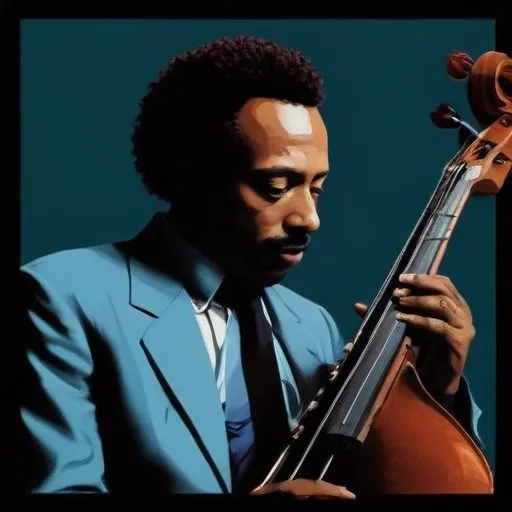
A renowned jazz double bassist, known for his smooth, melodic playing style and long-standing membership in the Modern Jazz Quartet.
Percy Heath, a legendary American jazz bassist, left an indelible mark on the music world with his virtuosic playing and collaborations with some of the greatest names in jazz. As a member of the iconic Modern Jazz Quartet (MJQ), Heath's melodic bass lines and impeccable rhythm section work helped shape the sound of jazz for decades.
Born on April 30, 1923, in Wilmington, North Carolina, Heath grew up in Philadelphia, surrounded by music. His father played the clarinet, and his mother sang in the church choir, instilling in him a deep love for music from an early age. Heath's musical journey began with the violin at eight, and he later sang locally in his teenage years.
After being drafted into the Army in 1944, Heath trained with the Tuskegee Airmen, graduating as a 2nd Lieutenant pilot. Although he saw no combat, his military experience would later influence his music. Post-war, Heath decided to pursue a career in music, buying a standup bass and enrolling in the Granoff School of Music in Philadelphia.
In the late 1940s, Heath moved to New York, where he began working with leading jazz musicians, including Dizzy Gillespie, Charlie Parker, and Thelonious Monk. His association with Gillespie's big band led to the formation of the Modern Jazz Quartet, featuring pianist John Lewis, drummer Kenny Clarke, and vibraphonist Milt Jackson.
When Ray Brown left the MJQ to join Ella Fitzgerald's band, Heath took his place, completing the quartet's classic lineup. Over the next two decades, the MJQ would become one of the most influential and beloved jazz groups of all time, known for their eclectic repertoire, virtuosic playing, and refined chamber jazz style.
In 1975, Heath joined forces with his brothers, saxophonist Jimmy Heath and drummer Albert "Tootie" Heath, to form the Heath Brothers. This family trio brought together three of jazz's most respected voices, blending their distinctive styles to create a unique sound that was both nostalgic and modern.
Percy Heath's legacy extends far beyond his work with the MJQ and the Heath Brothers. He played with a who's who of jazz legends, including Miles Davis, Wes Montgomery, and Lee Konitz, and appeared on countless recordings as a sideman and leader. Heath's bass playing was characterized by its lyricism, subtlety, and unwavering sense of swing.
Throughout his career, Heath received numerous accolades, including multiple Grammy nominations and a place in the DownBeat Jazz Hall of Fame. His influence can be heard in the playing of countless bassists who followed in his footsteps, including Ron Carter, Charlie Mingus, and Christian McBride.
Heath's life was marked by personal milestones, including his military service, his formation of the Heath Brothers, and his induction into the Jazz Hall of Fame. When asked about his approach to music, Heath once said, "I try to play from the heart, not from the head. I try to let the music speak for itself."
Percy Heath passed away on April 28, 2005, leaving behind a rich legacy that continues to inspire and influence generations of jazz musicians and enthusiasts alike.
99 Years Old
A legendary jazz saxophonist and composer who revolutionized the genre with his innovative, spiritually-driven improvisations and iconic albums like "A Love Supreme".
Born in 1926
A legendary jazz musician who revolutionized the genre with his improvisational style and iconic albums like "Kind of Blue". He's synonymous with cool, jazzy sophistication.
Born in 1917
A jazz legend who revolutionized piano playing and composition with unorthodox techniques and harmonies, creating a unique, improvisational style that continues to inspire generations of musicians.
Born in 1920
A pioneering jazz saxophonist and composer, known for his lightning-fast solos and innovative bebop style that revolutionized jazz music. 82
