


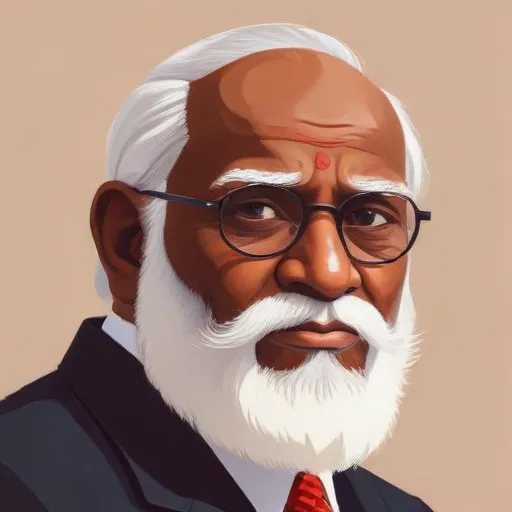
A pioneering social reformer who fought against casteism, superstition, and women's oppression, advocating for rationalism, equality, and women's empowerment. He is revered for his radical ideas and activism that transformed Indian society.
Known as the "Father of the Dravidian Movement," Periyar E. V. Ramasamy was a pioneering social activist, politician, and rationalist who dedicated his life to uprooting casteism, promoting social equality, and empowering the marginalized sections of Indian society. Through his relentless crusade against superstition, orthodoxy, and social injustice, Ramasamy left an indelible mark on modern Indian history.
Born on September 17, 1879, in Erode, Tamil Nadu, Ramasamy was exposed to the harsh realities of caste-based discrimination from a young age. His experiences as a member of the Naicker caste, considered inferior by the Brahminical hierarchy, instilled in him a deep sense of resentment towards the existing social order. The works of John Stuart Mill, Charles Bradlaugh, and other rationalist thinkers further fueled his convictions, shaping his worldview and igniting a passion for social reform.
Ramasamy's philosophical contributions were rooted in his unwavering commitment to rationalism, humanism, and atheism. He believed that social reform could only be achieved by dismantling superstition, myth, and the stranglehold of Brahminism. Through his writings and orations, he exhorted people to question and reject outdated customs, traditions, and beliefs that perpetuated inequality and social injustice.
In 1925, Ramasamy founded the Self-Respect Movement, which aimed to liberate marginalized castes from the shackles of Brahminical oppression. He launched a sustained attack on the caste system, famously burning copies of the Manusmriti, a sacred Hindu text, which he deemed responsible for perpetuating social inequality. His advocacy for inter-caste marriages, women's empowerment, and the rejection of religious rituals and superstitions earned him both admiration and vitriol from various quarters.
Ramasamy's radical ideas and activism have had a profound impact on modern Indian society. The Dravidian Movement he spearheaded has inspired generations of social reformers, politicians, and thinkers. His emphasis on social equality, women's empowerment, and rationalist thought has contributed significantly to shaping India's social fabric.
"He who cannot reform himself cannot reform others."
"We must establish a society where there is no scope for difference of opinion about the status of man and woman."
Ramasamy's life and work must be seen within the context of India's struggle for independence and social reform. His unwavering commitment to social justice and equality has left an enduring legacy, inspiring movements and thinkers across the country. Today, his ideas continue to resonate with marginalized communities, fostering a sense of pride, identity, and empowerment.
Ramasamy's influence extends beyond the realm of politics and social reform, permeating popular culture as well. Tamil cinema, literature, and art have been inspired by his ideas, with many films, novels, and plays exploring themes of social justice, casteism, and women's empowerment.
Periyar E. V. Ramasamy's remarkable life is a testament to the power of conviction, courage, and unwavering commitment to social justice. As we navigate the complexities of modern Indian society, his ideas and ideals continue to inspire, provoke, and challenge us to create a more equal, just, and rational world.
Born in 1891
Indian Minister of Law and Justice who fought for the rights of the marginalized and drafted the Indian Constitution, playing a key role in shaping modern India's democracy.
Born in 1869
Indian freedom fighter, activist, and philosopher who led India to independence from British rule through non-violent civil disobedience, inspiring civil rights movements worldwide.
Born in 1909
A pioneering Tamil politician and educator who played a key role in shaping Tamil Nadu's identity and politics, known for his advocacy of social justice and linguistic equality.
Born in 1917
A charismatic actor-turned-politician who dominated Tamil cinema and served as Chief Minister of Tamil Nadu, known for his on-screen heroics and off-screen populist policies.
Born in 1903
A pioneering Indian nationalist who played a key role in India's struggle for independence and later became a chief minister, known for his simple living and dedication to social welfare.
Born in 1878
The first Indian Governor-General of India, serving from 1948 to 1950, and a key figure in the country's struggle for independence from British rule. He was a strong advocate for non-violent resistance and played a crucial role in shaping India's early years.
Born in 1872
Indian independence activist and founder of the Swadeshi Steam Navigation Company, which competed with British shipping companies, promoting self-reliance and challenging colonial rule.
