


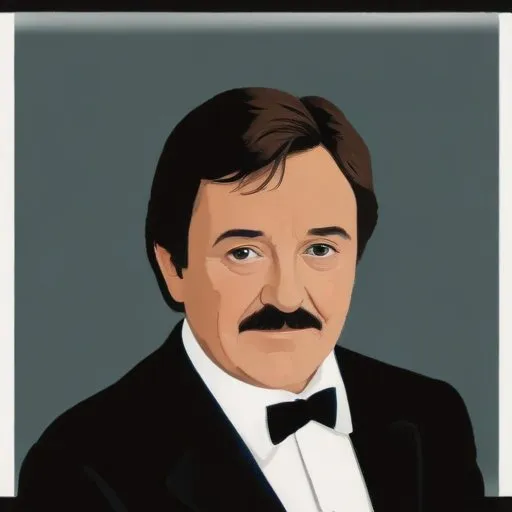
A renowned Australian composer and conductor, celebrated for his unique blend of Western classical music and Australian Aboriginal influences, creating a distinctive national sound.
Peter Sculthorpe, one of Australia's most celebrated composers, left an indelible mark on the music world with his unique blend of Western and Aboriginal influences. With a career spanning over six decades, Sculthorpe is renowned for his orchestral and chamber music, which captures the essence of the Australian bushland and outback.
Sculthorpe was born on April 29, 1929, in Launceston, Tasmania, to Edna and Joshua Sculthorpe. His parents' diverse interests had a profound impact on his early life. His mother, a lover of English literature, instilled in him a passion for the arts, while his father's love for nature and fishing sparked an appreciation for the great outdoors.
Sculthorpe's music career began at the tender age of seven, when he started taking piano lessons. Despite his teacher's discouragement, he continued to compose in secret, driven by a desire to create something unique and personal. By 14, he had decided to pursue music as a career, defying his father's wishes to explore other fields.
Sculthorpe's formal music education began at the Melbourne Conservatorium of Music, where he studied from 1946 to 1950. He later returned to Tasmania, where he continued to hone his craft. His early experiments with composition were influenced by Ernst Krenek's Studies in Counterpoint, a book he later described as "pretty dreadful."
Sculthorpe's music is characterized by its distinctive use of percussion, evoking the sounds of the Australian landscape. His work, which includes 18 string quartets, operas, and numerous chamber and orchestral pieces, reflects his deep connection with the natural world. Sculthorpe's goal was to create music that would uplift and inspire, making people "feel better and happier" for having listened to it.
Sculthorpe's contribution to Australian music is immeasurable. He is often compared to Aaron Copland, who played a similar role in shaping America's musical identity. His music has inspired generations of composers, and his influence can be heard in the works of many contemporary Australian musicians.
Peter Sculthorpe's legacy extends beyond his music. He was a passionate advocate for environmental and social causes, using his platform to raise awareness about important issues. Through his music and his life, Sculthorpe has left an indelible mark on Australian culture, cementing his place as one of the country's most beloved and respected composers.
Born in 1908
A pioneering composer of modern classical music, known for his complex and innovative works that pushed the boundaries of harmony and rhythm.
Born in 1925
A renowned French musician who revolutionized classical music with his avant-garde compositions and innovative conducting style, pushing boundaries and redefining the genre.
98 Years Old
A pioneer of electronic and avant-garde music, this composer pushed boundaries with unconventional sounds and performances, influencing generations of musicians and artists.
96 Years Old
A renowned Japanese composer and music theorist, blending Eastern and Western styles to create innovative, evocative soundscapes for film and concert halls.
Born in 1923
A visionary composer and educator who pushed the boundaries of classical music with his avant-garde and innovative works, blending dissonance and harmony in unique ways.
Born in 1913
A Polish composer and conductor who blended modernist and neoromantic styles, creating complex yet accessible orchestral works, including symphonies and concertos.
Born in 1922
A visionary composer who merged mathematics and music, creating complex, avant-garde works that pushed the boundaries of sound and performance.
Born in 1916
A renowned French pianist, composer, and educator, he was a prominent figure in 20th-century classical music, celebrated for his unique and innovative compositions.
