


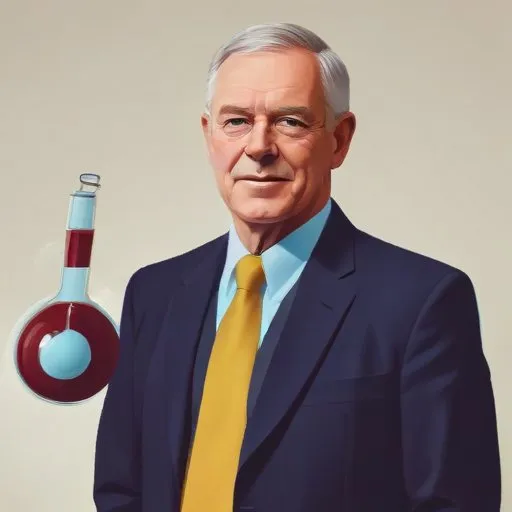
A pioneering chemical engineer who played a crucial role in the development of Australia's nuclear industry and was instrumental in establishing the country's first nuclear reactor. He also made significant contributions to the field of chemical engineering, particularly in the areas of reactor design and nuclear safety.
Sir Philip Baxter, a British chemical engineer, is renowned for his groundbreaking contributions to Australia's nuclear power development and his transformative leadership at the University of New South Wales. As a pioneer in the field, he played a pivotal role in shaping the country's nuclear energy landscape, earning him recognition as one of the most influential figures in Australian science.
Born on May 7, 1905, in Machynlleth, Wales, Baxter grew up in England and entered the University of Birmingham at the tender age of 16. His academic prowess led him to become a chemical engineer, eventually joining Imperial Chemical Industries (ICI) as a researcher.
At ICI, Baxter became the head of the Central Laboratory of its General Chemicals Division in Widnes, where he delved into the chemistry of chlorine and fluorine. During World War II, he played a crucial role in the British wartime nuclear weapons program, Tube Alloys, providing James Chadwick with samples of uranium hexafluoride. His expertise earned him a spot in Oak Ridge, Tennessee, where he assisted the Manhattan Project in 1944.
In 1949, Baxter joined the University of New South Wales (UNSW) as a professor of chemical engineering, marking the beginning of his Australian journey. As a vocal advocate for nuclear power, he became one of the most influential voices in the country's energy policy. He served as the chairman of the Australian Atomic Energy Commission from 1957 to 1972 and the International Atomic Energy Agency from 1969 to 1970.
Baxter's vision and leadership led to the construction of the High Flux Australian Reactor (HIFAR) at Lucas Heights, a milestone in Australia's nuclear research. His contributions extended beyond science, as he founded the National Institute of Dramatic Art (NIDA) and played a crucial role in the completion of the iconic Sydney Opera House.
Baxter's unwavering commitment to nuclear power stemmed from his conviction that it was the key to unlocking Australia's energy future. His advocacy for nuclear energy was rooted in his belief that it could provide a cleaner, more efficient alternative to traditional fossil fuels.
Baxter's tenure at UNSW saw him rise through the ranks, becoming the university's vice-chancellor in 1955. He remained in this position until 1969, leaving an indelible mark on the institution. His legacy is commemorated in the Philip Baxter College, named in his honor.
Sir Philip Baxter's remarkable life's work serves as a testament to the power of vision, leadership, and scientific innovation. As a trailblazer in the field of nuclear energy, he left an enduring impact on Australia's scientific landscape, cementing his place as one of the country's most esteemed figures.
Born in 1778
Pioneering chemist and physicist who discovered several elements, including potassium and sodium, and invented the Davy lamp, a safety lamp for miners. His groundbreaking work laid the foundation for modern chemistry and electrochemistry.
Born in 1791
Pioneering scientist who discovered electromagnetic induction, formulated the laws of electrolysis, and invented the first electrical generator, revolutionizing our understanding of electricity and its applications.
Born in 1920
A British chemist and academic who was awarded the Nobel Prize in Chemistry in 1967 for his work on flash photolysis, a technique used to study fast chemical reactions. He made significant contributions to the understanding of chemical kinetics and reaction mechanisms.
97 Years Old
A Nobel Prize-winning chemist and academic who made groundbreaking contributions to the understanding of chemical reactions and molecular structures. His work has had a significant impact on the development of modern chemistry.
Born in 1897
A British chemist who pioneered the study of chemical reactions, particularly in gases, and was awarded the Nobel Prize in Chemistry in 1956 for his work on the kinetics of chemical reactions.
