


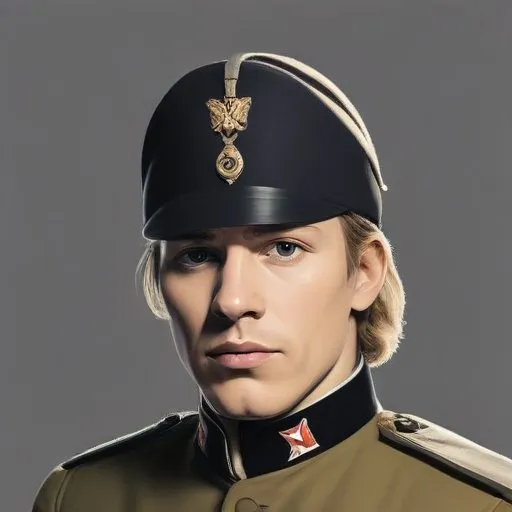
A Swedish military officer who led a dramatic and scandalous life, known for his alleged affair with Sophia Dorothea of Celle, which led to his mysterious disappearance.
Philip Christoph von Knigsmarck, a Swedish count and soldier, is most renowned for his alleged affair with Sophia Dorothea, Princess of Celle, the wife of Duke George Louis of Brunswick and Lüneburg, the heir presumptive of the Principality of Calenberg. This scandalous relationship would ultimately lead to his mysterious disappearance in 1694, leaving behind a trail of intrigue and speculation.
Born on March 4, 1665, in Stade, Knigsmarck was the grandson of the Swedish Field Marshal Hans Christoff von Knigsmarck and the nephew of the Swedish Field Marshal Otto Wilhelm Knigsmarck. His father, Count Kurt Christoph von Knigsmarck, and mother, Countess Maria Christina von Wrangel, were both members of the aristocracy. Knigsmarck's family was marked by a strong military tradition, with many of his relatives holding prominent positions in the Swedish army.
Knigsmarck's military career took him to various parts of Europe, where he fought in several battles and campaigns. He eventually entered the service of Ernest Augustus, Elector of Hanover, where he met Sophia Dorothea, Princess of Celle. During this time, he assisted the princess in her attempts to escape from her husband, Duke George Louis of Brunswick and Lüneburg.
The exact nature of Knigsmarck's relationship with Sophia Dorothea remains a topic of debate among historians. However, it is clear that the two shared a deep emotional bond, as evidenced by the numerous love letters Knigsmarck wrote to the princess, which are now preserved at the University of Lund. On the morning of July 2, 1694, after a meeting with Sophia at the Leineschloss castle, Knigsmarck was seized and disappeared, never to be seen again.
The circumstances of Knigsmarck's disappearance remain shrouded in mystery, fueling speculation and intrigue. Many theories have been proposed, including rumors of murder, imprisonment, and even a possible escape to the Middle East. Despite the uncertainty surrounding his fate, Knigsmarck's legacy as a symbol of love, passion, and tragedy has endured, captivating the imagination of historians and romantics alike.
Knigsmarck's life and career can be compared to that of his contemporaries, such as the French military commander Maurice de Saxe, who was also a member of European nobility. While both men lived lives marked by adventure and romance, their paths diverged significantly, with Knigsmarck's fate remaining a perpetual enigma.
In conclusion, Philip Christoph von Knigsmarck's life was marked by adventure, romance, and tragedy, leaving behind a legacy of intrigue and speculation. His story continues to captivate historians and romantics alike, reminding us of the complexities and mysteries of human nature.
Born in 1583
Lord High Chancellor of Sweden who played a crucial role in shaping the country's government and military during the 17th century, known for his diplomatic skills and administrative reforms.
Born in 1603
A renowned 17th-century military leader, he led Swedish forces to several victories in the Thirty Years' War, earning recognition as one of the greatest generals in Swedish history.
Born in 1613
A renowned military leader and statesman, he played a crucial role in shaping Sweden's history, particularly during the Thirty Years' War, and held significant political offices.
Born in 1596
A 17th-century Swedish military leader who fought in the Thirty Years' War and led troops to several victories, earning him a prominent place in Swedish history.
