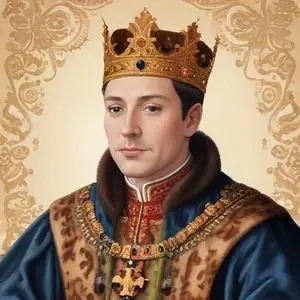
Philip III, Duke of Burgundy: The Ambitious Ruler of the Burgundian State
The Grandson of Philip the Bold
Philip III, Duke of Burgundy, is known for his strategic alliances, military conquests, and cultural patronage, which cemented the Burgundian State as a dominant power in 15th-century Europe. As the grandson of Philip the Bold, Philip III inherited a rich legacy of diplomatic and military prowess, which he leveraged to expand his territories and secure his family's grip on power.
Early Life and Accession
Born in 1396, Philip III was the son of
John the Fearless and Margaret of Bavaria. Following his father's assassination in 1419, Philip III succeeded him as the Duke of Burgundy, inheriting a state beset by internal conflicts and external threats. Despite these challenges, Philip III demonstrated remarkable resilience and adaptability, quickly establishing himself as a shrewd and ambitious ruler.
Military Campaigns and Territorial Expansion
Philip III's military campaigns were marked by a series of strategic alliances and calculated risks. He formed a tentative alliance with the English monarchy, securing crucial support against the French crown. This partnership enabled him to launch a successful campaign against the Duchy of Hainaut, incorporating it into the Burgundian State in 1429. Philip III's military prowess was further demonstrated in his victory over the rebels of Ghent in 1453, solidifying his control over Flanders.
Cultural Patronage and Architectural Legacy
Philip III was a vocal patron of the arts, commissioning numerous architectural projects that reflected the opulence and grandeur of the Burgundian State. His most notable patronage was the construction of the Church of Our Lady in Bruges, a magnificent example of Gothic architecture that remains one of the city's iconic landmarks. Additionally, he supported the work of renowned artists, including the Flemish painter Jan van Eyck, whose innovative techniques and attention to detail continue to influence art historians today.
Personal Milestones and Key Life Events
Philip III's personal life was marked by a series of significant milestones, including his marriage to
Isabella of Portugal in 1429, which cemented a crucial alliance with the Portuguese monarchy. The couple had three children, including
Charles the Bold, who would succeed Philip III as Duke of Burgundy. Philip III's later years were marked by a series of health issues, ultimately leading to his death in 1467.
Historical Context and Legacy
Philip III's reign was characterized by a delicate balancing act between the interests of the Burgundian State and the dynastic ambitions of his family. His strategic alliances, military campaigns, and cultural patronage helped secure the Burgundian State as a dominant power in 15th-century Europe. While his legacy was ultimately overshadowed by that of his successor, Charles the Bold, Philip III's contributions to the development of the Burgundian State remain significant, cementing his place as one of the most important rulers of the Middle Ages.
Comparative Analysis with Contemporaries
Philip III's reign coincided with that of other prominent European rulers, including
Henry V of England and
Charles VII of France. While these rulers were engaged in their own struggles for power and territory, Philip III's unique blend of diplomacy and military might enabled him to maintain a degree of independence and expand his territories. This comparative analysis highlights Philip III's adaptability and strategic thinking, which enabled him to navigate the complex web of alliances and rivalries that characterized 15th-century Europe.
Trivia and Fun Facts
- Philip III was known for his love of hunting, and his court was renowned for its elaborate hunting expeditions.
- The Duke was a patron of the Order of the Golden Fleece, a prestigious chivalric order founded by his father, Philip the Good.
- Philip III's tomb, located in the Church of Our Lady in Bruges, is adorned with intricate stone carvings and is considered one of the finest examples of Gothic funerary art in Europe.
Impact on Modern Society
Philip III's legacy extends beyond the boundaries of the Burgundian State, influencing the development of modern society in several key ways. His cultural patronage helped establish the Netherlands as a hub of artistic innovation, while his strategic alliances and military campaigns shaped the course of European politics for centuries to come. As a leader who embodied the principles of adaptability, diplomacy, and strategic thinking, Philip III's life and reign continue to inspire historians, politicians, and scholars today.
FAQ
What was Philip III, Duke of Burgundys role in European history?
Philip III, Duke of Burgundy played a significant role in European history, ruling Burgundy from 1419 to 1467 and expanding its territories through a series of strategic marriages and alliances.
What were Philip III, Duke of Burgundys territories?
Philip III, Duke of Burgundy ruled over a vast territory that included modern-day Belgium, the Netherlands, and parts of France, as well as several other regions in Europe.
What was Philip III, Duke of Burgundys relationship like with the Holy Roman Emperor?
Philip III, Duke of Burgundy had a complex relationship with the Holy Roman Emperor, often vying for power and influence in Europe. He was also a rival of the French monarchy.
What were some of Philip III, Duke of Burgundys notable achievements?
Philip III, Duke of Burgundy is credited with promoting the arts and culture, and establishing the Order of the Golden Fleece, a prestigious chivalric order. He also strengthened the economy of Burgundy through trade and commerce.
How did Philip III, Duke of Burgundys reign come to an end?
Philip III, Duke of Burgundys reign came to an end in 1467, when he died and was succeeded by his son, Charles the Bold.