


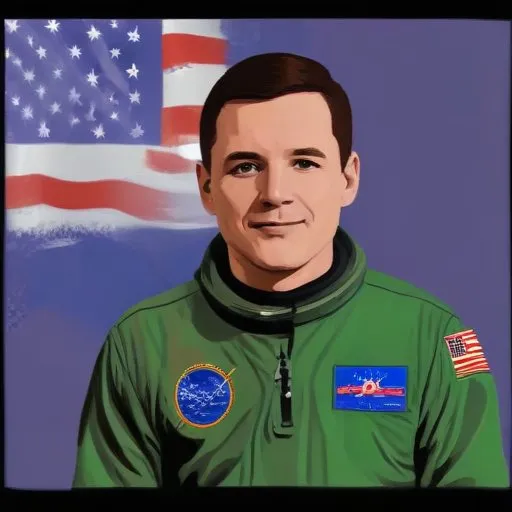
One of the first scientists-astronauts, he flew on the Apollo 14 mission and was a pioneer in spacewalks, contributing significantly to our understanding of space exploration.
Philip K. Chapman, a name synonymous with space exploration, is renowned for being the first Australian-born American astronaut. Serving for about five years in NASA Astronaut Group 6 (1967), Chapman's remarkable journey is a testament to his unwavering dedication to the field.
Born on March 5, 1935, in Melbourne, Australia, Chapman's family relocated to Sydney during his childhood. He attended the Fort Street Opportunity School, followed by Parramatta High School. His educational pursuits led him to the University of Sydney, where he earned a B.S. in physics and mathematics in 1956.
Chapman's thirst for knowledge took him to the Massachusetts Institute of Technology (MIT) in the United States, where he earned a M.S. in aeronautics and astronautics in 1964 and a Sc.D. in instrumentation in 1967. Notably, his doctoral thesis advisors included Nobel Laureates Steven Weinberg and Rainer Weiss.
Chapman's professional journey began with the Royal Australian Air Force Reserve, where he served from 1953 to 1955. He learned to fly in a Tiger Moth during Australian National Service.
From 1956 to 1957, he worked for Philips Electronics Industries Proprietary Limited in Sydney, Australia. Chapman's most notable expedition was his 15-month stint in Mawson Station, Antarctica, as an auroral-radio physicist with the Australian National Antarctic Research Expeditions (ANARE) for the International Geophysical Year (IGY) in 1958.
This period saw him spend most of the winter at a remote, 2-man base near the world's largest Emperor penguin rookery, near Taylor Glacier. During this time, Chapman explored the local area, becoming the first human to climb Chapman Ridge, which he and his team members dubbed Mount Rumdoodle.
Philip K. Chapman's remarkable journey has left an indelible mark on the world of space exploration. His contributions to the field of aeronautics and astronautics have paved the way for future generations of space enthusiasts.
As we reflect on Chapman's life and achievements, we are reminded of the power of human curiosity and the importance of pushing boundaries in the pursuit of knowledge.
96 Years Old
First person to walk on the Moon during the Apollo 11 mission, marking a historic milestone in space exploration.
96 Years Old
Second man to walk on the Moon during the Apollo 11 mission, a pioneering astronaut and advocate for space exploration.
96 Years Old
Led the third manned mission to land on the Moon, Apollo 12, and became the third person to walk on its surface. Known for his bold and fearless approach to space exploration.
94 Years Old
One of the 12 humans to walk on the Moon during NASA's Apollo program, known for his moonwalk during Apollo 12 and later becoming a painter, capturing the beauty of space through art.
98 Years Old
American baseball player who pitched in the Major Leagues from 1965 to 1975, known for being a four-time All-Star and winning the American League ERA title in 1968.
Born in 1925
One of the original Mercury Seven astronauts, he orbited the Earth in 1962, paving the way for future space exploration. He was also a decorated naval aviator and aquanaut.
Born in 1923
One of the original seven astronauts in Project Mercury, this pioneer flew on three historic spaceflights, including the first American manned orbital flight and the Apollo 7 mission.
99 Years Old
One of the original seven astronauts in Project Mercury, he was the first American to spend over a day in space and the last to fly solo in orbit, paving the way for future space exploration.
