


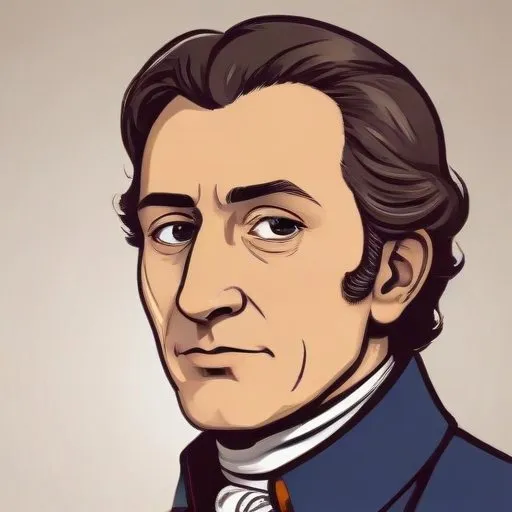
A French historian, explorer, and author who traveled extensively in North America, documenting Native American cultures and mapping the Great Lakes region. His writings provide valuable insights into 18th-century colonial America.
Pierre Franois Xavier de Charlevoix, a French Jesuit priest, traveller, and historian, is often regarded as the first historian of New France. His extensive writings on the history and culture of North America paved the way for future historians and scholars.
Charlevoix was born on 24 or 29 October 1682, in Saint-Quentin, Picardy, France, to a family of lesser nobility. His father held the position of deputy attorney general, and his ancestors had served in positions of great trust and high responsibility such as legal officers, aldermen, and mayors.
At the age of 16, Charlevoix entered the Jesuit novitiate in Paris, where he studied philosophy at the College Louis-le-Grand from 1700 to 1704. He then spent four years in Quebec, Canada, where he taught grammar and underwent his period of training in the Society, known as the regency.
Upon returning to Paris, Charlevoix studied theology and became a professor of belles lettres. One of his students was the young Voltaire, who would later develop strong views on New France. Charlevoix was ordained as a priest in 1713 and published his first complete work, a treatise on the establishment and progress of the Catholic Church in Japan, in 1715.
In 1720, Charlevoix embarked on a journey to New France, commissioned by the French government to survey the historic boundaries of Acadia, a French colony ceded to the British Empire in the 1713 Peace of Utrecht. This journey marked the beginning of his extensive travels throughout North America, during which he gathered valuable information and insights that would later inform his writings.
Charlevoix's most notable work is his Histoire et description générale de la Nouvelle-France, a comprehensive history of New France, which was published in three volumes between 1744 and 1756. This work is considered a seminal text in the field of Canadian history and provides valuable insights into the culture, politics, and daily life of the indigenous peoples and early European settlers.
In addition to his historical writings, Charlevoix also made significant contributions to the fields of geography, anthropology, and natural history. His works are characterized by their meticulous attention to detail, thorough research, and engaging narrative style.
Charlevoix's writings have had a profound impact on our understanding of New France and its history. His work has influenced generations of historians, scholars, and writers, and continues to be studied and appreciated today.
As a pioneering historian of New France, Charlevoix's legacy extends beyond the academic community. His work has contributed to a greater understanding of the complex cultural exchange between European settlers and indigenous peoples, and has helped to shape our appreciation of the rich cultural heritage of North America.
Charlevoix's life and work serve as a testament to the power of curiosity, scholarship, and adventure. His pioneering spirit and dedication to the pursuit of knowledge have left an indelible mark on our understanding of New France and its rich cultural heritage.
Born in 1567
French explorer who mapped much of eastern North America, establishing trade and settlement in what is now Canada and the northeastern United States.
Born in 1643
French explorer who led expeditions to explore the Great Lakes and Mississippi River, claiming the region for France and opening it to further European exploration.
Born in 1626
The first Intendant of New France was a key figure in establishing and governing the French colony, overseeing its economic development, and implementing policies to ensure its growth and prosperity. They played a crucial role in shaping the colony's early years.
Born in 1645
French-Canadian explorer who charted the Mississippi River and claimed the region for France, opening up the Midwest to further exploration and settlement.
Born in 1637
French missionary and explorer who established missions in the Great Lakes region and mapped many of its rivers and lakes, including the Mississippi River. He played a key role in the European exploration of North America.
