


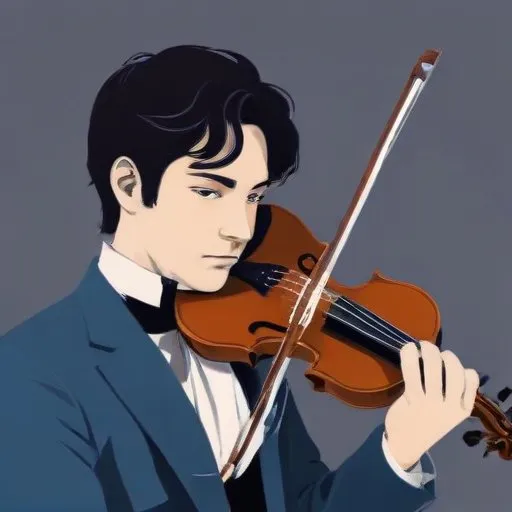
A virtuosic violinist and composer, known for his technical mastery and expressive playing style, leaving a lasting impact on the development of Romantic violin music.
Known for his exceptional talent and innovative compositions, Pierre Rode was a French violinist and composer who left an indelible mark on the music world. As a favourite pupil of the renowned Giovanni Battista Viotti, Rode inherited his teacher's style, adding his own unique touch and refined tone to create a distinct sound that enthralled audiences across Europe.
Born on February 16, 1774, in Bordeaux, Aquitaine, France, Rode traveled to Paris in 1787 to hone his skills under the guidance of Viotti. The great maestro was so impressed with the young pupil's talent that he waived his tuition fee, recognizing Rode's potential to become a violin virtuoso.
Rode's collaboration with Baillot and Kreutzer on the official Violin Method of the Conservatoire de Paris, published in 1802, solidified his reputation as a leading figure in the music world. As violin soloist to Napoleon, he toured extensively throughout Europe, performing in the Netherlands, Germany, England, and Spain. His sojourn in Saint Petersburg from 1804 to 1809, where he stayed with François-Adrien Boieldieu, further expanded his artistic horizons.
Rode's concertos, written from 1814 to 1819 during his time in Berlin, showcased his mastery of the genre. The 24 Caprices in all major and minor keys, composed during this period, remain a testament to his innovative spirit and technical prowess. Ludwig van Beethoven, impressed by Rode's artistry, dedicated his last violin sonata, Op. 96, to the French virtuoso.
A lymphatic infection caused by streptococcus bacteria affected Rode's right arm, reducing his ability to play with force and rapidity. Despite this health issue, he continued to perform, although his playing style was criticized by some as becoming "cold and full of mannerism." In 1828, Rode made a final attempt at a public concert in Paris, but it was met with disappointment, reportedly hastening his demise.
Pierre Rode passed away on November 25, 1830, at the Château de Bourbon near Damazan, Lot-et-Garonne, in his native Aquitaine. His compositions, characterized by their elegance and refinement, continue to influence generations of violinists. Rode's legacy serves as a testament to his dedication to his craft and his unwavering passion for music.
Born in 1782
A virtuosic violinist and composer who revolutionized the instrument's technical possibilities, leaving an indelible mark on classical music.
Born in 1770
A musical genius who expanded the possibilities of classical music, creating iconic symphonies and piano sonatas that continue to inspire and influence generations of artists.
Born in 1756
A child prodigy and master of classical music, he composed over 600 works, including symphonies, operas, and chamber music, that continue to inspire and influence musicians today.
Born in 1811
A virtuosic pianist and composer who revolutionized classical music with his technically demanding and emotionally expressive works, blending Hungarian folk influences with Romantic-era drama.
Born in 1833
A renowned pianist and composer, he crafted complex, expressive works that blended traditional and innovative techniques, leaving an indelible mark on classical music.
Born in 1678
A virtuosic violinist and prolific composer, he crafted over 400 concertos, including "The Four Seasons," which remains a beloved and iconic masterpiece of classical music.
Born in 1835
A French Romantic-era mastermind who composed iconic works like "The Carnival of the Animals" and "Danse Macabre", leaving an indelible mark on classical music.
Born in 1822
A Belgian organist and composer who created iconic works that blended Romanticism and Impressionism, leaving a lasting impact on classical music.
