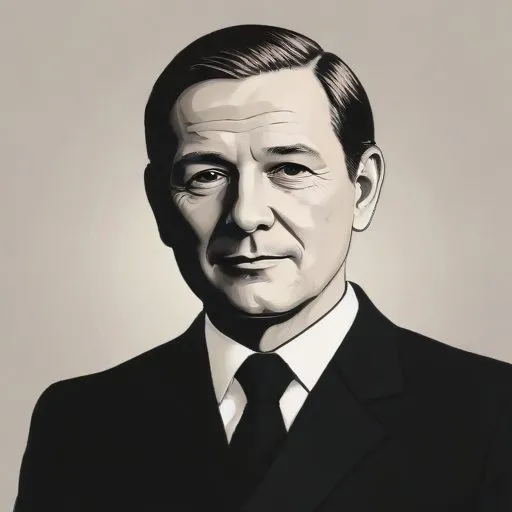
Pieter Sjoerds Gerbrandy: The Dutch Statesman and Prime Minister
A Leader in Exile
Pieter Sjoerds Gerbrandy is renowned for his pivotal role as the Prime Minister of the Netherlands during World War II, leading the government-in-exile from 1940 to 1945. Under his leadership, the Dutch government continued to function in London, despite the German occupation of the Netherlands, earning him a place in history as a champion of resistance and determination.
Early Life and Education
Born on April 13, 1885, in the village of Gonga, near Sneek, in the province of Friesland, Gerbrandy was an ethnic Frisian. His name, styled in the traditional Frisian way, reveals his heritage: first name Pieter, patronymic Sjoerds, meaning son of Sjoerd, and family name Gerbrandy. After completing his secondary education, Gerbrandy pursued higher studies at the Vrije Universiteit Amsterdam, where he majored in law. He obtained his doctorate in law in January 1911 and began his professional career as a lawyer and prosecutor.
Early Political Career
Gerbrandy's foray into politics started in 1916, when he became a member of the Municipal Council of Sneek. He simultaneously served as a member of the Provincial Council of Friesland from 1919 to 1920 and the Provincial Executive of Friesland from 1920 to 1930. During this period, he was affiliated with the Anti-Revolutionary Party (ARP). In 1939, despite his party's initial reservations, Gerbrandy was appointed Minister of Justice, a position that would prepare him for his future role as Prime Minister.
World War II and the Government-in-Exile
Following the German victory at the Battle of the Netherlands in 1940, the Dutch royal family and many leading politicians fled to London to establish a government-in-exile. After Dirk Jan de Geer's resignation, Queen Wilhelmina appointed Gerbrandy as Prime Minister of the Dutch government-in-exile. In addition to his role as Prime Minister, Gerbrandy also served as Minister of Justice and Minister of Colonial Affairs, demonstrating his unwavering commitment to the Dutch people and their cause.
Post-War and Legacy
After the liberation of the southern Netherlands in 1945, Gerbrandy's government-in-exile was dissolved, and he returned to the Netherlands. His leadership during the war years had cemented his position as a statesman and a symbol of Dutch resistance against the German occupation. Gerbrandy passed away on September 7, 1961, leaving behind a legacy that has endured for generations.
Historical Context and Significance
Gerbrandy's tenure as Prime Minister was marked by his unwavering commitment to the Dutch people and their interests. His leadership during World War II was instrumental in maintaining the sovereignty and dignity of the Netherlands, even in the face of overwhelming odds. His role as a symbol of resistance and hope has inspired generations of Dutch citizens and continues to be celebrated to this day.
Career Highlights and Major Works
- Member of the Municipal Council of Sneek (1916-1930)
- Member of the Provincial Council of Friesland (1919-1930)
- Minister of Justice (1939)
- Prime Minister of the Dutch government-in-exile (1940-1945)
- Minister of Justice and Minister of Colonial Affairs (1940-1945)
Influence on Modern Society
Gerbrandy's leadership during World War II has had a lasting impact on Dutch politics and society. His unwavering commitment to the Dutch people and their cause has inspired generations of politicians and citizens alike. His legacy serves as a reminder of the importance of courage, determination, and leadership in the face of adversity.
FAQ
What were Pieter Sjoerds Gerbrandys most notable achievements as a politician?
Pieter Sjoerds Gerbrandy was a Dutch politician who served as the Prime Minister of the Netherlands during World War II. He played a crucial role in leading the Dutch government-in-exile and coordinating the countrys resistance to Nazi occupation.
How did Pieter Sjoerds Gerbrandys experience as a lawyer inform his approach to politics?
As a lawyer, Pieter Sjoerds Gerbrandy brought a strong understanding of the law and a commitment to justice to his political work, which enabled him to navigate the complexities of international law and diplomacy during wartime.
What was the significance of Pieter Sjoerds Gerbrandys role in the Dutch resistance movement?
Pieter Sjoerds Gerbrandy played a key role in the Dutch resistance movement, working closely with other leaders to coordinate resistance activities and promote cooperation between different groups.
How did Pieter Sjoerds Gerbrandys political career impact his personal life?
Pieter Sjoerds Gerbrandys political career had a profound impact on his personal life, as he often found himself balancing the demands of politics with his family and personal relationships.
What legacy did Pieter Sjoerds Gerbrandy leave in Dutch politics?
Pieter Sjoerds Gerbrandy left a lasting legacy in Dutch politics, marked by his leadership, courage, and commitment to democracy. He remains a revered figure in Dutch history, and his contributions continue to inspire future generations of politicians and citizens.