


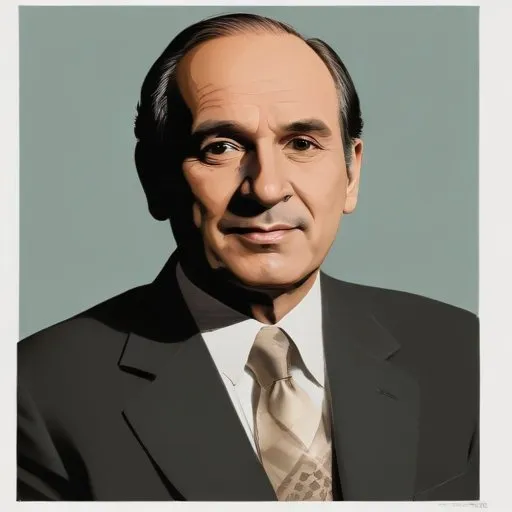
A humanitarian leader who served as the United Nations High Commissioner for Refugees, known for his tireless efforts to protect and provide aid to refugees and displaced persons around the world.
Prince Sadruddin Aga Khan, the uncle of the current Aga Khan, is renowned for his tireless efforts to alleviate human suffering and promote global understanding. As a revered diplomat, humanitarian, and environmentalist, he dedicated his life to serving humanity, earning him the nickname " Shia Islam's Diplomatic Ambassador."
Born on January 17, 1933, in Paris, France, Prince Sadruddin was the son of Sultan Mahomed Shah Aga Khan III and Princess Andrée Aga Khan. He was educated at the prestigious Swiss private school, Le Rosey, and later at Harvard University, where he graduated with a degree in literature and philosophy.
Prince Sadruddin's diplomatic career spanned over three decades, during which he served as the United Nations High Commissioner for Refugees (UNHCR) from 1966 to 1977. Under his leadership, the UNHCR was awarded the Nobel Peace Prize in 1954 and 1961. He played a pivotal role in shaping the organization's response to refugee crises, including the displacement of Bangladeshis following the country's liberation war.
A passionate environmentalist, Prince Sadruddin founded the Bellerive Foundation in 1977, which focused on protecting the world's cultural and natural heritage. He was also an ardent supporter of the International Union for Conservation of Nature (IUCN), serving as its deputy president from 1988 to 1993.
Prince Sadruddin was deeply rooted in his Ismaili Muslim faith, which guided his humanitarian work. He believed in the importance of promoting interfaith dialogue and understanding, often emphasizing the significance of compassion, justice, and empathy.
Through his humanitarian work, Prince Sadruddin inspired countless individuals to dedicate their lives to serving others. His legacy continues to inspire leaders, policymakers, and global citizens to prioritize the well-being of humanity and the planet.
Prince Sadruddin's vision for a more harmonious and compassionate world continues to resonate with people today. As the global community faces increasingly complex challenges, his legacy serves as a beacon of hope, inspiring future generations to work towards a brighter future.
The Prince Sadruddin Aga Khan Fund for the Environment was established in 2001 to support environmental initiatives around the world. His philanthropic efforts have improved the lives of countless individuals, from refugees to marginalized communities.
One of Prince Sadruddin's most remarkable qualities was his ability to inspire people from all walks of life. His compassion, empathy, and selflessness continue to motivate individuals to make a positive impact in the world.
As we reflect on the life and legacy of Prince Sadruddin Aga Khan, we are reminded of the transformative power of humanitarian service, environmental stewardship, and interfaith understanding. His remarkable journey serves as a testament to the enduring impact one person can have on the world.
88 Years Old
A renowned international diplomat who led the United Nations from 1997 to 2006, promoting global cooperation and development, and receiving the Nobel Peace Prize in 2001.
89 Years Old
The authoritarian leader who ruled Iraq with an iron fist, notorious for his brutal suppression of dissent and invasion of neighboring countries.
Born in 1922
The first Arab to lead the United Nations, he played a key role in shaping international relations and global governance during a tumultuous period in the 1990s. He's also known for his efforts to reform the UN and promote peacekeeping operations.
93 Years Old
A French military officer and statesman who served as President of France from 1995 to 2007, known for his opposition to the US-led invasion of Iraq and his efforts to strengthen the European Union.
88 Years Old
A renowned international diplomat who led the United Nations from 1997 to 2006, promoting global cooperation and development, and receiving the Nobel Peace Prize in 2001.
89 Years Old
A Finnish statesman and Nobel laureate who served as President of Finland and mediated several international conflicts, earning him the Nobel Peace Prize in 2008.
72 Years Old
The first female Chancellor of Germany, serving for 16 years, known for her leadership during the European sovereign-debt crisis and her role in shaping the European Union's policy. She's a highly influential figure in modern politics.
82 Years Old
The 8th Secretary-General of the United Nations, a South Korean politician and diplomat who played a crucial role in promoting global peace, security, and sustainable development. He's known for his efforts to combat climate change and advocate for human rights.
