


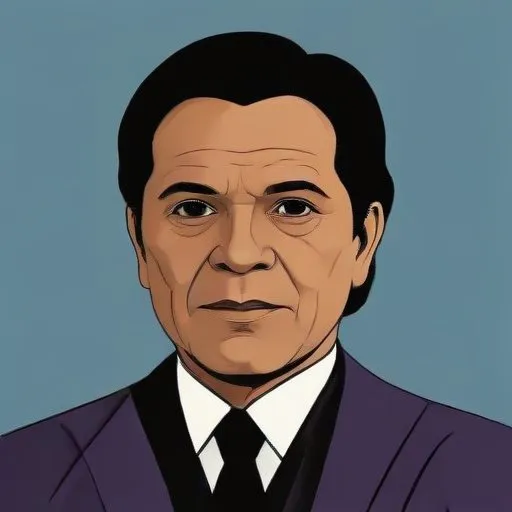
A Brazilian lawyer and politician who served as the country's third president, known for his efforts to modernize and stabilize the young nation during a tumultuous period. He's remembered for his strong leadership and commitment to democracy.
As the third president of Brazil, Prudente de Morais stands out as a trailblazer in the country's history, marking a significant shift towards democracy and civilian leadership. He is notable for being the first civilian president of Brazil, elected by direct popular ballot under the permanent provisions of Brazil's 1891 Constitution, and the first to serve his full term in office.
Born on October 4, 1841, in the vicinity of Itu, São Paulo, Prudente de Morais' ancestry dated back to the early Portuguese settlers of Brazil. Orphaned at the age of three, he was raised by his mother and stepfather in the city of São Paulo, where he completed his primary education.
In 1863, Morais graduated with a law degree from the Law School of São Paulo, today's Faculty of Law of the University of São Paulo. He practiced law in Piracicaba for two years before beginning his political career in 1865.
During the period of the Empire of Brazil, Morais was an active member of the Liberal Party, advocating for monarchist values and was also part of the local freemason lodge. His political career took off in 1865 when he was elected as an alderman.
In the following years, Morais held various positions, including Governor of the State of São Paulo and President of the Senate from 1891 to 1894. He played a crucial role in the Constituent Congress that drafted and approved Brazil's 1891 Constitution.
Morais' presidency, which lasted from 1894 to 1898, was marked by significant challenges, including the War of Canudos, a peasant revolt in the northeast of the country that was eventually crushed by the Brazilian Army.
He also navigated a diplomatic crisis with Portugal, which was successfully mediated by Queen Victoria of the United Kingdom. Despite these challenges, Morais remained committed to his vision for Brazil, working tirelessly to strengthen the country's institutions and infrastructure.
The city of Presidente Prudente, located in the western part of São Paulo, was named in his honor, a testament to his enduring legacy in Brazilian politics.
Morais' presidency set a new standard for civilian leadership in Brazil, paving the way for future generations of politicians. His commitment to democracy, social justice, and national development continues to inspire Brazilians to this day.
Morais married Adelaide Benvinda da Silva Gordo in Piracicaba in 1866, and the couple had several children together. Despite his busy political career, he remained devoted to his family and community.
Prudente de Morais' presidency had a profound impact on modern Brazilian society, shaping the country's political landscape and institutions. His commitment to democracy, social justice, and national development continues to influence Brazilian politics and society today.
In comparison to his contemporaries, Morais stood out for his strong leadership, vision, and commitment to democracy. His presidency marked a significant departure from the previous monarchist regime, setting a new standard for civilian leadership in Brazil.
While his presidency was not without its challenges, Morais' legacy continues to inspire Brazilians, offering a model of democratic leadership and national development that remains relevant today.
Born in 1882
A dominant leader who ruled Brazil from 1930 to 1945 and again from 1951 until his suicide in 1954, known for implementing reforms and promoting nationalism.
Born in 1918
A Brazilian lawyer and politician who served as the 24th President of Brazil, known for his left-wing policies and nationalization of industries, leading to a military coup that ousted him.
Born in 1910
A Brazilian lawyer and politician who served as Prime Minister of Brazil, known for being the first civilian to assume the office after a long period of military rule. He's also famous for dying before taking office, sparking a national crisis.
96 Years Old
Brazil's 33rd President, a skilled engineer and politician, led the country during a period of economic crisis and implemented significant reforms. He's most known for stabilizing the economy and introducing the Real Plan.
95 Years Old
A renowned sociologist and politician who served as President of Brazil from 1995 to 2003, implementing economic reforms and stabilizing the country's economy. He's also a respected academic and writer.
