


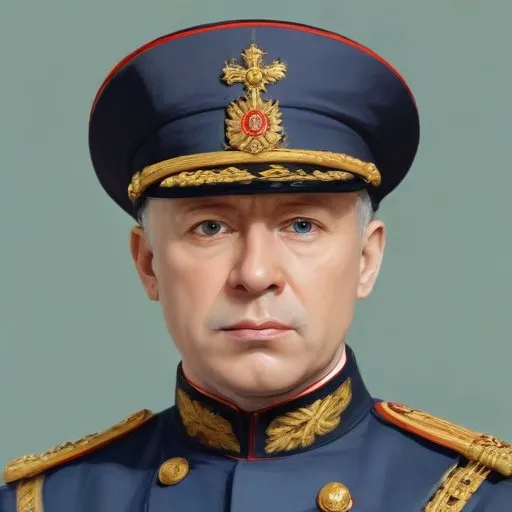
A Russian general who led the White Army in the Russian Civil War, fighting against the Bolsheviks and later fleeing to exile. He's most known for his anti-communist efforts and attempts to restore the Russian monarchy.
Pyotr Nikolayevich Wrangel, a Russian general, is notoriously remembered as the last Commander-in-Chief of the Imperial Russian Army and the leader of the White Army in southern Russia during the Russian Civil War. His valiant efforts to salvage the crumbling empire and restore the Romanov dynasty in the face of Bolshevik revolutionaries would earn him a reputation as a dogged defender of the old regime.
Born on August 15, 1878, in Novalexandrovsk, Mikhailovsky Uyezd, Yekaterinoslav Governorate, Russian Empire (present-day Ukraine), Wrangel haled from a noble family of Baltic-German descent. His early life was marked by a strong interest in military affairs, and he went on to graduate from the prestigious Page Corps, a Russian military academy, in 1896.
Following the October Revolution of 1917, Wrangel became a vocal opponent of the Bolsheviks and eventually joined the White Army, a loose confederation of anti-Bolshevik forces. In 1920, he took command of the Russian Army in Crimea, determined to defeat the Red Army and restore the monarchy.
Under his leadership, the White Army achieved several crucial victories, including the capture of Tsaritsyn (now Volgograd) and the conquest of the Kuban region. However, Wrangel's forces were ultimately forced to retreat to Crimea, where they were besieged by the Red Army.
In the face of imminent defeat, Wrangel made the difficult decision to evacuate his troops and civilians from Crimea to Turkey. The perilous journey, which became known as the "Wrangel's Exodus," saw over 100,000 people flee Russia, marking one of the largest refugee crises in history.
The evacuation, orchestrated by Wrangel and his staff, was a remarkable feat of military logistics, but it also cemented his reputation as a defeated leader, forced to abandon his homeland.
Wrangel settled in Serbia, where he continued to advocate for the restoration of the Russian monarchy. He became the president of the Russian All-Military Union, an organization dedicated to promoting the interests of Russian émigrés.
Despite his dogged determination, Wrangel's health began to decline, and he passed away on April 25, 1928, in Budapest, Hungary. His remains were later transferred to Belgrade, where he was laid to rest in the New Cemetery.
Pyotr Nikolayevich Wrangel's legacy is complex and multifaceted. While some view him as a hero who fought valiantly against the Bolsheviks, others see him as a relic of a bygone era, clinging to a discredited monarchy.
Regardless, Wrangel's story serves as a poignant reminder of the turbulent era in which he lived, a time of great upheaval and transformation in Russian politics, society, and culture. His name has become synonymous with bravery, duty, and loyalty, and his legacy continues to inspire and fascinate historians and enthusiasts alike.
As the last standard-bearer of Imperial Russia, Wrangel's story is a testament to the enduring power of human resilience and the indomitable will to fight for a lost cause.
Born in 1870
Founder of the world's first socialist state, leading the Bolshevik Revolution and establishing the Soviet Union, known for his radical Marxist ideology and authoritarian rule.
Born in 1879
Founded the Red Army and played a crucial role in the Russian Revolution, shaping the course of modern communism. A key figure in 20th-century politics and ideology.
Born in 1878
The Soviet Union's ruthless leader who ruled with an iron fist, implementing policies that led to widespread famine and purges, while also playing a crucial role in defeating Nazi Germany in World War II.
Born in 1874
A Russian naval officer who led a White Army faction during the Russian Civil War and was a renowned Arctic explorer, credited with discovering the Northeast Passage.
Born in 1872
A Russian general who led the White Army against the Bolsheviks during the Russian Civil War, known for his attempts to restore the Russian monarchy.
Born in 1870
A Russian general and explorer who led a failed coup against the provisional government in 1917 and was a prominent figure in the Russian Civil War. He's also known for his expeditions in Turkestan and the discovery of the ancient city of Khiva.
Born in 1896
A Soviet military leader who played a crucial role in defeating Nazi Germany in World War II, and later became a key figure in Soviet politics.
Born in 1895
Head of the Soviet secret police, responsible for millions of arrests, torture, and executions during Stalin's Great Purge, earning the nickname "The Poison Dwarf".
