


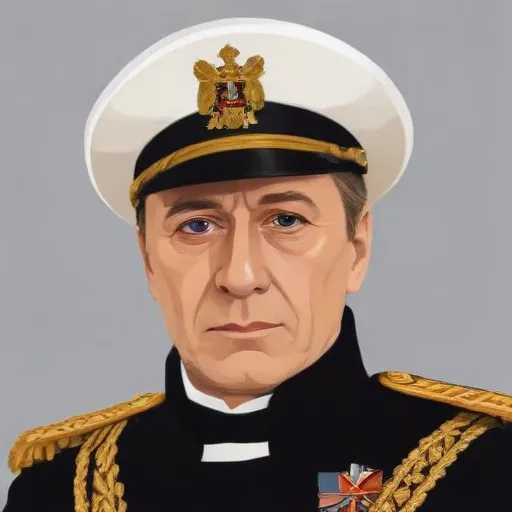
A Russian naval officer who led a White Army faction during the Russian Civil War and was a renowned Arctic explorer, credited with discovering the Northeast Passage.
Alexander Kolchak is best known for his remarkable career as a Russian admiral, military leader, and polar explorer, who held the title of Supreme Ruler of Russia from 1918 to 1920 during the Russian Civil War.
Kolchak was born on November 4, 1874, in Saint Petersburg, into a family of Moldavian origins. His father, a retired major-general of the marine artillery, had a significant influence on Kolchak's early life, instilling in him a love for the sea and a sense of adventure.
Kolchak's education was geared towards a naval career, and he graduated from the Naval Cadet Corps in 1894. He joined the Imperial Russian Navy and quickly made a name for himself as a skilled and daring officer. During the Russo-Japanese War, Kolchak distinguished himself as a brave and resourceful commander, earning several awards and promotions.
In 1900, Kolchak participated in the Russian Polar Expedition, led by Eduard Toll, which aimed to explore the Arctic region and find the mythical Sannikov Land. Although the expedition was ultimately unsuccessful, Kolchak's experience and skill in navigating the treacherous Arctic waters earned him recognition as a leading expert in polar exploration.
During World War I, Kolchak served in the Imperial Russian Navy and was appointed as the Minister of War and Navy in the Provisional All-Russian Government in 1918. Following a coup in November 1918, Kolchak was installed as the Supreme Ruler of Russia, with his government based in Omsk, southwestern Siberia.
Although Kolchak's authority was initially recognized by the other leaders of the White movement, his control over Russian territory was limited, and his forces suffered a series of defeats against the Red Army. Despite initial successes in early 1919, Kolchak's government ultimately collapsed, and he was betrayed and handed over to the Bolsheviks, who executed him in February 1920.
Alexander Kolchak's remarkable life and career have left an indelible mark on Russian history. His bravery, skill, and sense of adventure inspired generations of Russians, and his legacy continues to be felt in the fields of polar exploration and naval warfare.
Kolchak's rise to power during the Russian Civil War was marked by a complex web of alliances and rivalries with other leaders of the White movement, including Anton Denikin and Mikhail Alekseyev. While Kolchak's government ultimately failed to unite the counter-revolutionary movements, his leadership and military prowess earned him recognition as one of the most significant figures of the Russian Civil War.
In comparative analysis, Kolchak's leadership style and military strategy have been likened to those of other notable military leaders, including Napoleon Bonaparte and Robert E. Lee. His bravery and sense of adventure have drawn comparisons to explorers such as Roald Amundsen and Robert Falcon Scott.
Alexander Kolchak's remarkable life and career serve as a testament to his bravery, skill, and sense of adventure. Despite the complexities and challenges of his time, Kolchak remains an enduring figure in Russian history, inspiring generations to come.
Born in 1870
Founder of the world's first socialist state, leading the Bolshevik Revolution and establishing the Soviet Union, known for his radical Marxist ideology and authoritarian rule.
Born in 1878
The Soviet Union's ruthless leader who ruled with an iron fist, implementing policies that led to widespread famine and purges, while also playing a crucial role in defeating Nazi Germany in World War II.
Born in 1879
Founded the Red Army and played a crucial role in the Russian Revolution, shaping the course of modern communism. A key figure in 20th-century politics and ideology.
Born in 1895
Head of the Soviet secret police, responsible for millions of arrests, torture, and executions during Stalin's Great Purge, earning the nickname "The Poison Dwarf".
Born in 1877
Founder of the Soviet secret police, known for his role in establishing the Cheka, a precursor to the KGB, and implementing repressive policies during the Russian Revolution.
Born in 1907
A pioneering rocket engineer and designer who played a crucial role in the Soviet space program, developing the R-7 rocket that launched Sputnik and sent humans into space.
Born in 1896
A Soviet military leader who played a crucial role in defeating Nazi Germany in World War II, and later became a key figure in Soviet politics.
Born in 1896
A Soviet military leader who played a crucial role in several key battles, including the Battle of Stalingrad and the capture of Berlin, earning him the highest military honors. He was a skilled strategist and tactician who helped turn the tide of the war in favor of the Allies.
