


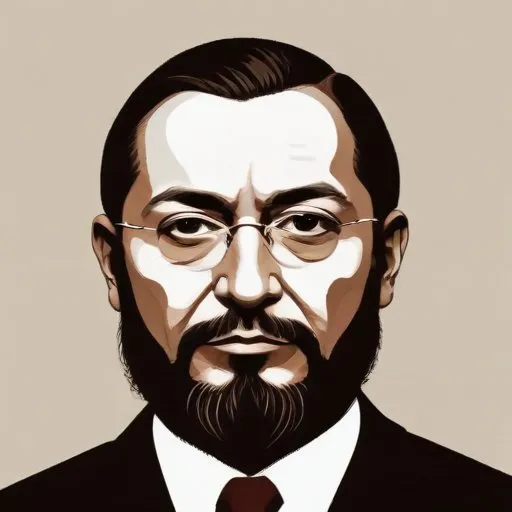
A Soviet mathematician and logician who made significant contributions to the development of mathematical logic, particularly in the areas of proof theory and constructive mathematics.
Pyotr Sergeyevich Novikov was born on August 15, 1901, in Moscow, Russia, to Sergei Novikov, a merchant, and Alexandra Novikov. His early life was marked by service in the Red Army during the Russian Civil War from 1920 to 1922, after which he pursued higher education.
Novikov studied at Moscow University from 1919 to 1920 and again from 1922 until he graduated in 1925. He continued his graduate studies under the guidance of Nikolai Luzin, a renowned Russian mathematician, until 1929.
Novikov's contributions to mathematics are primarily in the field of group theory. He is known for his work on combinatorial problems in group theory, particularly the word problem for groups, and his progress in the Burnside problem.
In 1955, Novikov proved the Novikov-Boone theorem, which states that there is a finite presentation of a group S R for which there is no algorithm that can decide whether two words u and v describe the same element in the group. This groundbreaking theorem has had a significant impact on the development of group theory.
Novikov's contributions to mathematics were recognized with several prestigious awards and honors. He was elected as a corresponding member of the Academy of Sciences of the Soviet Union in 1953 and became a full member in 1960.
In 1957, he was awarded the Lenin Prize for his proof of the undecidability of the word problem in groups. Additionally, he received the Order of Lenin in 1961.
Novikov's work has had a lasting impact on the development of group theory and its applications in modern mathematics. His students, including Sergei Adian and Albert Muchnik, went on to become prominent mathematicians in their own right.
Novikov's contributions have also influenced other areas of mathematics, such as mathematical logic and combinatorics. His legacy continues to inspire mathematicians today, and his work remains a fundamental part of the subject.
Throughout his career, Novikov was dedicated to teaching and mentoring. He worked at the Moscow D. Mendeleev Institute of Chemical Technology from 1929 to 1934 and later joined the Department of Real Function Theory at the Steklov Institute of Mathematics.
In 1944, he became the head of the Department of Analysis at the Moscow State Teachers Training Institute, and in 1957, he became the first head of the Department of Mathematical Logic at the Steklov Institute. He jointly held both positions until his retirement in 1972 and 1973, respectively.
Novikov's son, Sergei Novikov, also became a mathematician, following in his father's footsteps.
Novikov passed away on January 9, 1975, in Moscow, leaving behind a legacy of mathematical contributions that continue to shape the field.
Born in 1903
Developed theories on probability, topology, and complexity, making significant contributions to modern mathematics and computer science.
Born in 1908
Developed the theory of distributions, a fundamental concept in mathematics, and made significant contributions to the fields of calculus, functional analysis, and partial differential equations.
Born in 1908
A renowned mathematician who made significant contributions to topology, algebra, and differential equations, particularly in the development of Pontryagin duality and Pontryagin classes.
Born in 1856
Developed the theory of Markov chains, a mathematical system that undergoes transitions from one state to another, and is widely used in computer science, biology, and economics.
Born in 1894
Developed the Chebotaryov density theorem, a fundamental concept in number theory, and made significant contributions to the field of algebra.
Born in 1869
A prominent mathematician and academic who made significant contributions to the development of differential geometry and topology, and was a key figure in the Moscow Mathematical Society.
Born in 1901
Developed theories on algebraic geometry and partial differential equations, making significant contributions to the field of mathematics.
