


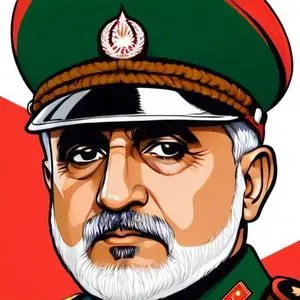
The commander of Iran's elite special forces, known for secretly backing militant groups and orchestrating proxy wars across the Middle East, earning him the nickname "Shadow Commander."
Qasem Soleimani was the commander of the Quds Force, a division of the Islamic Revolutionary Guard Corps (IRGC) responsible for extraterritorial and clandestine military operations, and played a key role in securing Russian intervention in the Syrian Civil War. Dubbed the "single most powerful operative in the Middle East" and a "genius of asymmetric warfare," Soleimani's strategies had personally tightened a noose around Israel's neck, according to former Mossad director Yossi Cohen.
Soleimani was born on March 11, 1957, in the village of Qanate Malek, Kerman Province. He left school at the age of 13 to work on a construction site and repay his father's agricultural debts. In 1975, he began working as a contractor for the Kerman Water Organization, where he developed his physical strength through weight training in local gyms. His path to power was also influenced by his attendance at the sermons of Hojjat Kamyab, a preacher and protégé of Ali Khamenei, who encouraged him to revolve his life around Islamic principles.
Soleimani's military career spanned over three decades, during which he played a crucial role in shaping Iran's military strategy and foreign policy. He was appointed as the commander of the Quds Force in 1998, and under his leadership, the force expanded its operations across the Middle East, Latin America, and Africa. Some of his notable achievements include:
Soleimani's influence extended beyond the military realm, shaping Iran's foreign policy and domestic politics. He was considered the righthand man of the Supreme Leader of Iran, Ali Khamenei, and the second-most powerful person in Iran behind Khamenei. His assassination in 2020 led to widespread mourning in Iran, with the government launching missiles against U.S. military bases in Iraq in retaliation.
Soleimani's worldview was deeply rooted in Islamic principles and a strong sense of nationalism. He believed in the importance of asymmetric warfare, stating that "it is the art of creating power from weakness." His strategies were guided by a deep understanding of Sun Tzu's The Art of War, which he often quoted and applied to modern warfare.
Soleimani's life was marked by several significant events, including:
Soleimani's legacy is complex and multifaceted, with some hailing him as a national hero and others condemning him as a terrorist. His death sparked widespread mourning in Iran, with many viewing him as a symbol of resistance against Western imperialism. However, his actions were also criticized by many, who saw him as a mastermind of violence and destabilization in the region.
"We are not afraid of the enemy. The enemy is afraid of us."
"The war in Syria is a war on behalf of the Islamic Republic, and it is our duty to defend it."
| 1957 | Born on March 11 in Qanate Malek, Kerman Province |
| 1975 | Began working as a contractor for the Kerman Water Organization |
| 1998 | Appointed as the commander of the Quds Force |
| 2005 | Designated as a terrorist by the United States |
| 2011 | Led the IRGC's operations in Syria, securing Russian intervention in the civil war |
| 2020 | Assassinated by a targeted drone strike on January 3, in Baghdad, Iraq |
Soleimani's life and legacy continue to shape the Middle East's political landscape, inspiring both admiration and criticism from around the world.
77 Years Old
The 7th President of Iran, a moderate reformist who advocated for nuclear diplomacy and economic reform, known for his efforts to improve relations with the West.
87 Years Old
The current Supreme Leader of Iran, who has been in power since 1989, is known for his conservative and anti-Western views, and for holding significant influence over the country's political and religious affairs.
60 Years Old
The current President of Syria, known for his authoritarian rule and involvement in the Syrian Civil War, which has led to widespread human suffering and global political tensions.
73 Years Old
A Russian politician who has dominated the country's politics for over two decades, known for his authoritarian leadership style and controversial foreign policy decisions.
65 Years Old
Leader of the Lebanese political and militant group Hezbollah, known for his strong anti-Israel stance and involvement in regional conflicts.
63 Years Old
A senior Hezbollah commander and mastermind behind numerous high-profile terrorist attacks, including the 1983 Beirut barracks bombing that killed hundreds of American and French servicemen.
69 Years Old
Iran's sixth president, a controversial figure known for his anti-Western rhetoric and disputed re-election, who sparked global concern over Iran's nuclear program.
