


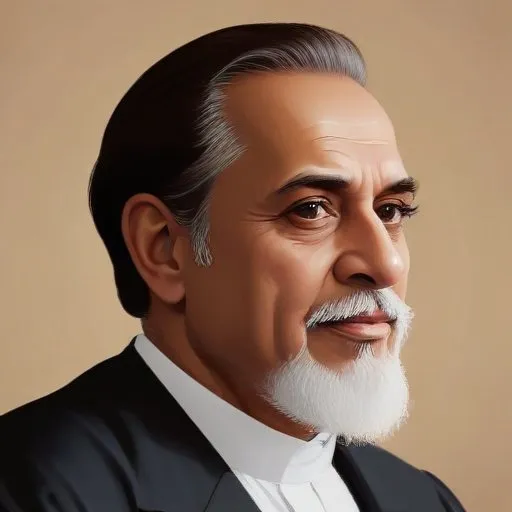
A prominent Islamic scholar and politician who served as the Emir of Jamaat-e-Islami, a major Pakistani political party, and was a vocal critic of Western influence in Pakistan. He was known for his conservative views and advocacy for Islamic law.
Qazi Hussain Ahmad is renowned for his unrelenting efforts as an Islamic scholar, democracy activist, and former Emir of JamaateIslami, a socially conservative Islamist political party in Pakistan. Through his unwavering stance, he opposed the United States' participation in the war against the Taliban in neighboring Afghanistan, solidifying his position as a vocal advocate for Islamic values and democracy.
Born on January 12, 1938, in Ziarat Kaka Sahib, Nowshera District, KhyberPakhtunkhwa, Pakistan, Ahmad was the youngest among his ten siblings. His early education took place at home, where he developed a strong foundation in Islamic studies. He later attended Islamia College, Peshawar, and earned his Master of Science (MSc) degree in geography from Peshawar University.
Ahmad's academic and professional journey was marked by distinct milestones. He began his career as a lecturer at Jehanzeb College Swat, teaching at the graduate level for three years. His entrepreneurial spirit then led him to start his own business, and he was elected as the Vice-President of the KhyberPakhtunkhwa Provincial Chamber of commerce and industry.
Ahmad's personal life was deeply rooted in his faith and family. He was married and had two sons, Asif Luqman Qazi and Anas Farhan Qazi, and two daughters. His family members were all active participants in JamaateIslami, reflecting the strong bond between his personal and professional life. He was also an ardent admirer of the poet Allama Muhammad Iqbal, frequently incorporating quotes from Iqbal's Urdu and Persian poetry in his speeches and conversations.
Ahmad's association with the Islamic Movement began during his school days, when he joined Islami JamiateTalaba, Pakistan. In 1970, he became a member of JamaateIslami and was elected as the President of its Peshawar branch. He later served as the Secretary and Ameer of its KhyberPakhtunkhwa provincial branch, solidifying his position as a leader in the Islamist political party.
Ahmad's philosophical contributions were deeply rooted in Islamic values and democracy. He firmly believed in the importance of Islamic principles in governance and advocated for their implementation in Pakistani politics. His unwavering stance against the United States' involvement in Afghanistan reflected his commitment to promoting Islamic values and democracy in the region.
Qazi Hussain Ahmad's legacy extends far beyond his political career. He remains an inspiration to those who share his passion for Islamic values and democracy. His unwavering commitment to his beliefs has left an indelible mark on Pakistani politics and beyond, solidifying his position as a respected Islamic scholar and democracy activist.
Ahmad's life serves as a testament to the power of conviction and dedication to one's beliefs. As we reflect on his remarkable journey, we are reminded of the importance of promoting Islamic values and democracy in our own lives, and striving to make a positive impact on the world around us.
Born in 1877
A Pakistani philosopher, poet, and politician who played a key role in the creation of Pakistan and is revered for his philosophical and literary works that explored Islamic identity and nationalism.
74 Years Old
A legendary cricketer who led Pakistan to World Cup victory in 1992, and later became the country's Prime Minister, known for his charismatic leadership and anti-corruption stance.
83 Years Old
The Pakistani general and politician who seized power in a military coup and ruled Pakistan from 1999 to 2008, known for his controversial presidency and attempted assassination. He played a key role in Pakistan's politics and foreign policy during a tumultuous period.
76 Years Old
The 12th Prime Minister of Pakistan, known for his three non-consecutive terms in office and his role in shaping the country's economy and foreign policy. He was ousted from power in 2017 due to corruption charges.
98 Years Old
A charismatic leader who served as Pakistan's president and prime minister, known for his socialist and nationalist policies, and his role in developing Pakistan's nuclear program.
Born in 1924
A Pakistani general and politician who ruled Pakistan from 1978 to 1988, implementing Islamic law and playing a key role in the Soviet-Afghan War. He's known for his authoritarian regime and controversial legacy.
Born in 1907
Led the military coup in 1958, becoming the President of Pakistan and implementing various reforms, including the 1962 Constitution. He's known for his authoritarian rule and modernization efforts.
