


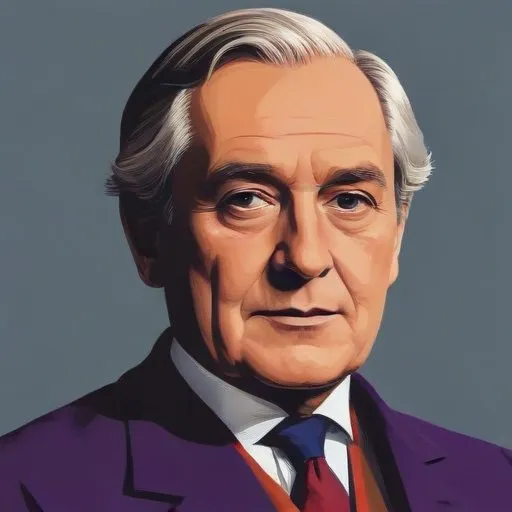
A renowned academic and politician who served as Lord High Chancellor of Great Britain, known for his influential role in shaping the country's legal and political landscape. He was a strong advocate for the British monarchy and a vocal critic of liberal reforms.
Quintin Hogg, Baron Hailsham of St Marylebone, was a British barrister and Conservative Party politician who left an indelible mark on British politics. As a former Lord Chancellor, contender for the leadership of the Conservative Party, and a life peer, Hogg's impressive career spanned over six decades, earning him a reputation as a devoted public servant.
Born on October 9, 1907, in Bayswater, London, Hogg was the son of Douglas Hogg, 1st Viscount Hailsham, who was Lord Chancellor under Stanley Baldwin. His American mother and grandfather, Quintin Hogg, a merchant, philanthropist, and educational reformer, instilled in him a strong sense of duty and public service.
Hogg's educational background was impressive, to say the least. He attended Sunningdale School and then Eton College, where he was a King's Scholar and won the Newcastle Scholarship in 1925. He later entered Christ Church, Oxford, as a Scholar and became President of the Oxford University Conservative Association and of the Oxford Union. He took Firsts in Honours Moderations in 1928 and in Literae Humaniores in 1930. A Prize Fellowship in Law at All Souls College, Oxford, in 1931 further solidified his academic credentials.
Hogg's entry into politics was swift and decisive. He participated in his first election campaign in the 1924 general election and continued to do so until his death. In 1938, he became a Conservative candidate for the Oxford University constituency.
In 1950, Hogg succeeded his father as the 2nd Viscount Hailsham, but he renounced his hereditary peerage in 1963 to contest the leadership of the Conservative Party. Although he was passed over in favor of Sir Alec Douglas-Home, he was created a life peer in 1970 and served as Lord Chancellor from 1970 to 1974 and again from 1979 to 1987.
Hogg's political career was not without controversy. He sparked debate when he spoke in opposition to the motion "That this House will in no circumstances fight for its King and Country" in the 1933 King and Country debate at the Oxford Union. This stance was seen as pacifist, and Hogg faced criticism for his views.
Quintin Hogg, Baron Hailsham of St Marylebone, left behind a legacy of dedication to public service and politics. His commitment to the Conservative Party and his country earned him the respect of his peers and the admiration of the British people.
Hogg married Natalie Sylvia Davson in 1932, and they had four children together. He passed away on October 12, 2001, at the age of 94, leaving behind a rich legacy in British politics.
Hogg's remarkable life was a testament to his unwavering commitment to public service, politics, and his country. His contributions to British politics continue to inspire generations of politicians and public servants alike.
Image credits: Public domain
Born in 1871
Prolific writer of historical novels and adventure stories, also a talented landscape painter.
Born in 1894
A British politician who served as Prime Minister from 1957 to 1963, known for leading the country through a period of economic prosperity and decolonization.
Born in 1903
A British aristocrat who served as Prime Minister from 1963 to 1964, known for his brief tenure and aristocratic background.
Born in 1912
A British politician who served as Secretary of State for Health, infamous for his controversial "Rivers of Blood" speech on immigration, sparking national debate and outrage. He was a polarizing figure in British politics.
Born in 1916
The Prime Minister who led the UK into the European Economic Community (EEC) and navigated the country through a period of economic and industrial turmoil. He's also known for his diplomatic efforts, particularly in regards to the Cold War.
Born in 1912
A British politician who served as Prime Minister from 1976 to 1979, known for his efforts to stabilize the economy and navigate the country through a period of industrial unrest.
Born in 1885
Won the 1952 Olympic Games marathon in Helsinki, Finland, and held the world record in the marathon from 1952 to 1953.
Born in 1925
The first female Prime Minister of the United Kingdom, serving from 1979 to 1990, known for her conservative policies and leadership during the Falklands War.
