


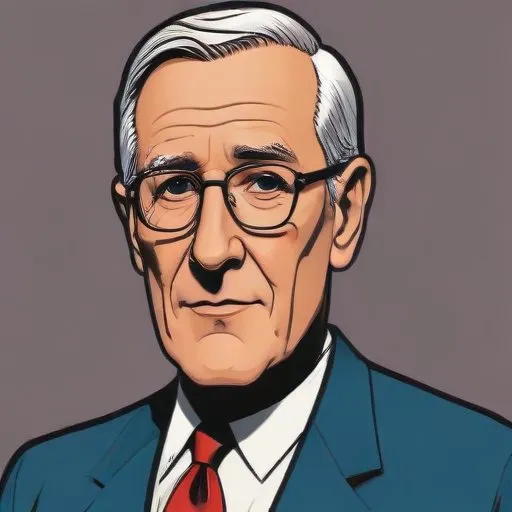
A lawyer and politician who served in the US Senate from 1957 to 1971, known for his liberal views and advocacy for civil rights, education, and environmental protection.
Ralph Yarborough, known affectionately as "Smilin' Ralph," was a Texas Democratic politician who served in the United States Senate from 1957 to 1971, leaving an indelible mark on the nation's struggle for civil rights. He was a progressive leader who fearlessly defied the norms of his time, refusing to sign the 1956 Southern Manifesto, which opposed racial integration in public places.
Yarborough's commitment to social justice was evident from the start of his career. Born in Chandler, Texas, on June 8, 1903, he practiced law in El Paso after graduating from the University of Texas School of Law. His experience as an assistant to Texas Attorney General James Burr V. Allred in 1931 laid the foundation for his future role as a champion of the people.
During World War II, Yarborough served in the United States Army, and upon his return, he ran for governor of Texas several times, opposing the conservative faction of Democrats led by Allan Shivers. His persistence paid off when he won the special election to fill the Senate seat vacated by Price Daniel in 1957.
Yarborough's unwavering support for civil rights legislation earned him a reputation as a leader of the progressive wing of his party. He voted in favor of the Civil Rights Acts of 1957, 1960, 1964, and 1968, as well as the 24th Amendment to the U.S. Constitution, the Voting Rights Act of 1965, and the confirmation of Thurgood Marshall to the U.S. Supreme Court.
In a remarkable display of courage, Yarborough was the only senator from a former Confederate state to vote for all five landmark civil rights bills. His commitment to equality and justice paved the way for significant social reforms in the United States.
Yarborough's folksy charm and down-to-earth demeanor made him a beloved figure on the campaign trail. His signature slogan, "Let's put the jam on the lower shelf so the little people can reach it," resonated with ordinary Americans who felt neglected by the political establishment.
In 1964, Yarborough faced off against George H.W. Bush, the Harris County Republican Party Chairman, and won the election by a significant margin. This victory cemented his reputation as a force to be reckoned with in Texas politics.
Yarborough was a stalwart supporter of President Lyndon B. Johnson's Great Society legislation, which aimed to address poverty, inequality, and social injustice. He played a crucial role in shaping policies that led to the creation of Medicare and Medicaid, as well as federal support for education and the arts.
Throughout his political career, Yarborough remained true to his values, never wavering in his pursuit of social justice and equality. His legacy continues to inspire generations of Americans who strive for a more just and equitable society.
Yarborough's witty phrases and folksy wisdom continue to delight and inspire:
Ralph Yarborough's legacy is a testament to the power of courage, conviction, and unwavering commitment to social justice. As we reflect on his remarkable life, we are reminded of the importance of standing up for what is right, even in the face of adversity.
Born in 1908
The 36th President of the United States, a skilled politician and leader, played a crucial role in passing landmark civil rights legislation, including the Civil Rights Act and Voting Rights Act.
Born in 1917
The 35th President of the United States was a charismatic leader who navigated the country through the Cuban Missile Crisis and advocated for civil rights, leaving a lasting legacy in American politics.
Born in 1882
A prominent lawyer and politician who served as the 48th Speaker of the United States House of Representatives, known for his influential leadership and legislative prowess.
Born in 1911
The 38th Vice President of the United States was a prominent liberal politician and journalist who played a key role in shaping the country's civil rights policies. He's most known for his strong support of the Civil Rights Act of 1964.
Born in 1924
The 41st President of the United States, a decorated war hero and skilled diplomat, led the country through the end of the Cold War and Gulf War. He's known for his foreign policy expertise and "kinder, gentler nation" vision.
Born in 1921
The 69th United States Secretary of the Treasury, a strong advocate for free trade and fiscal responsibility, famously clashed with Dan Quayle in a 1988 VP debate.
80 Years Old
A Texas Democrat serving in the U.S. House of Representatives since 1995, known for his progressive stance on issues like healthcare and education.
