


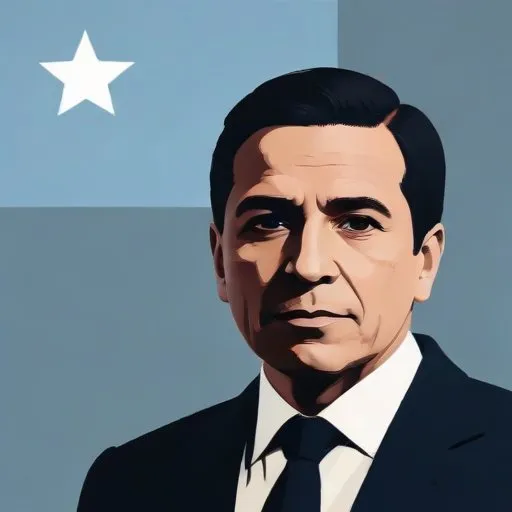
An Argentine politician who served as President of Argentina from 1942 to 1943, known for his conservative and nationalist policies. He played a significant role in shaping the country's political landscape during a tumultuous period.
Ramón Castillo, a prominent Argentine politician, served as the President of Argentina from June 27, 1942, to June 4, 1943, during the infamous decade characterized by electoral fraud, corruption, and rule by conservative landowners. He was a leading figure in the Concordancia, an alliance of conservative politicians that dominated Argentine politics during this period.
Born on November 20, 1873, in Buenos Aires, Argentina, Castillo graduated in law from the University of Buenos Aires (UBA) and began a judicial career. He rose through the ranks, eventually becoming a professor and dean at UBA between 1923 and 1928.
Castillo's political career began as the Federal Intervenor of Tucumán Province in 1930. From 1932 to 1935, he was elected to the Argentine Senate for Catamarca Province as a member of the National Democratic Party. He later served as Minister of Interior.
Between 1938 and 1942, Castillo held the position of Vice President of Argentina under President Roberto Ortiz, who won the election through fraudulent means as the head of the Concordancia. When President Ortiz fell ill, Castillo took over as acting president from July 3, 1940, to June 27, 1942.
Castillo's presidency was marked by Argentina's neutrality during World War II. However, his attempt to impose Robustiano Patrón Costas as his successor led to his downfall in the Revolution of '43, a military coup. Juan Domingo Perón, a junior officer at the time, was involved in the coup.
After his overthrow, Castillo lived in retirement until his death on October 12, 1944. His legacy is tainted by the corruption and electoral fraud that characterized his time in power.
Castillo's presidency was a product of the Concordancia's fraudulent electoral practices, and his rule was marked by corruption and authoritarianism. Despite this, he played a significant role in maintaining Argentina's neutrality during World War II. However, his legacy is largely overshadowed by the controversies surrounding his presidency.
Despite his controversial presidency, Ramón Castillo remains an important figure in Argentine history, serving as a reminder of the importance of fair electoral practices and transparency in government.
Born in 1895
The authoritarian leader who ruled Argentina with his charismatic wife Eva, implementing populist economic policies and promoting nationalism, while suppressing opposition and civil liberties.
Born in 1919
A former actress who used her charisma and influence to advocate for women's suffrage and workers' rights, becoming a beloved and powerful figure in Argentine politics.
Born in 1908
Lawyer and politician who served as President of Argentina from 1958 to 1962, known for his efforts to modernize the country's economy and infrastructure. He also established diplomatic relations with the Soviet Union, a significant move during the Cold War era.
99 Years Old
The first democratically elected president of Argentina after a period of military rule, known for his efforts to promote human rights and democracy in the country.
96 Years Old
The 50th President of Argentina, a lawyer-turned-politician who implemented neoliberal economic policies and pardoned military officers involved in human rights abuses during the country's Dirty War. He's also known for his flamboyant style and corruption scandals.
88 Years Old
Led Argentina through a tumultuous period, implementing economic reforms and navigating corruption scandals, while also being a key figure in the country's transition to democracy. Known for his efforts to stabilize the economy and promote human rights.
