


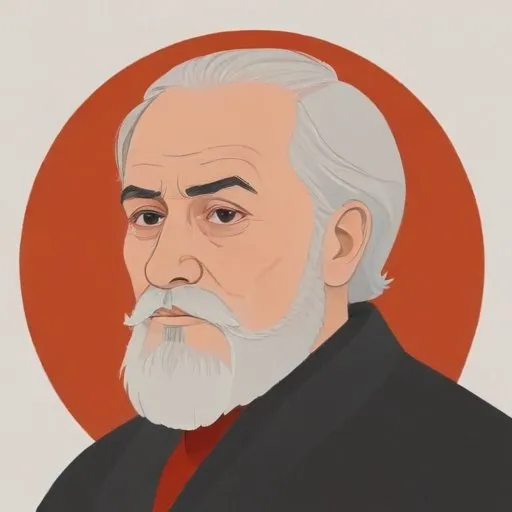
A renowned Avar poet and lyricist, celebrated for his heartfelt verses that beautifully capture the essence of Caucasus culture and folklore.
Rasul Gamzatov is renowned for his poignant poetry, which has left an indelible mark on the literary landscape of Russia and beyond. Born on September 8, 1923, in the Avar village of Tsada in the northeast Caucasus, Gamzatov's works are a testament to the rich cultural heritage of the region, and his poem "Zhuravli" has become a beloved Soviet song.
Gamzatov's fascination with words began at a young age. His father, Gamzat Tsadasa, was a well-known bard, and the young Rasul would often listen to his father's tales and verses, which sparked his own creative inclinations. At just 11 years old, Gamzatov penned his first poem, inspired by a group of local boys who had gathered to marvel at a plane's landing in the nearby clearing. This early brush with creativity set the stage for a lifetime of poetic expression.
Gamzatov's journey was marked by diversity and creativity. He studied at the Pedagogical College, graduating in 1939, and went on to work as a school teacher, assistant director in a theater, journalist, and radio host. His experiences in these various roles enriched his writing, allowing him to tap into the heartbeat of the people and the land. From 1945 to 1950, he honed his craft at the Maxim Gorky Literature Institute, solidifying his position as a revered poet.
Gamzatov's contributions to literature did not go unnoticed. He received the State Stalin Prize in 1952, the Lenin Prize in 1963, and the Laureate of the International Botev Prize in 1981. These honors recognized his role in shaping the literary landscape of Russia and beyond.
Rasul Gamzatov's life was punctuated by significant milestones. He passed away on November 3, 2003, at the age of 80, leaving behind a body of work that continues to inspire generations. He was laid to rest in the old Muslim cemetery in Tarki, beside his wife's grave. A monument to Gamzatov was unveiled on July 5, 2013, on Yauzsky Boulevard in central Moscow, a testament to his enduring legacy.
Gamzatov's poetry is infused with a deep sense of cultural identity and a connection to the natural world. His works often explored the human condition, love, and the importance of preserving cultural heritage. His philosophical contributions lie in his ability to distill the essence of the Caucasus region, revealing its beauty, complexity, and resilience.
Rasul Gamzatov's poetry has transcended borders, inspiring countless artists, writers, and musicians. His works continue to influence modern society, serving as a reminder of the power of cultural expression to bring people together and foster understanding. His legacy serves as a testament to the importance of preserving and celebrating cultural diversity.
"The poet's task is to paint the beauty of the world with the colors of his own heart."
This quote, among many others, encapsulates Gamzatov's approach to poetry, highlighting the importance of emotional authenticity and creative expression.
93 Years Old
A prominent Russian poet and playwright, known for his bold and provocative works that often critiqued Soviet politics and society, earning him both acclaim and controversy.
Born in 1890
A Russian literary giant, renowned for his poetic and novelistic masterpieces, including the epic "Doctor Zhivago", which captured the essence of Soviet Russia. His works are a testament to the power of literature in shaping cultural identity.
Born in 1889
A renowned poet and literary icon of the Soviet era, celebrated for her poignant and evocative works that captured the essence of love, loss, and resilience amidst war and oppression.
Born in 1893
A Russian avant-garde artist who revolutionized poetry and theater with his bold, futuristic style and passionate performances. He's most famous for his vibrant, propaganda-inspired posters and poems that captured the spirit of the Russian Revolution.
Born in 1892
A Russian poet and author who poured her heart into lyrical verses, exploring themes of love, nature, and the human condition. Her works are a testament to her intense emotional depth and poetic genius.
Born in 1880
A leading figure of the Russian Symbolist movement, known for his lyrical and mystical poetry that explored the human condition and the search for meaning. His works are considered a bridge between 19th-century Romanticism and 20th-century Modernism.
Born in 1895
A renowned Russian poet, known for his lyrical and patriotic works that often romanticized rural Russia, and his tumultuous life that ended in tragedy at a young age.
