


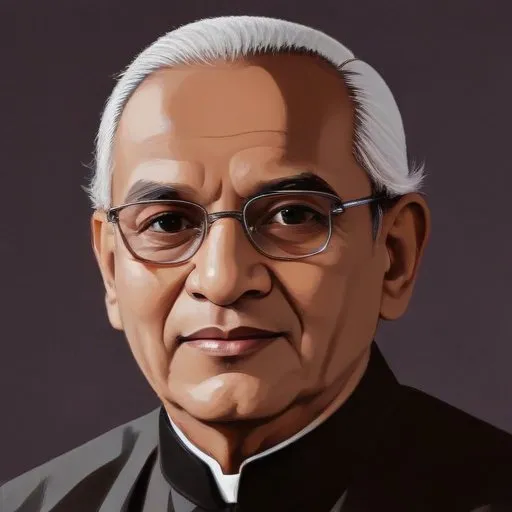
First Chief Minister of Madhya Pradesh, instrumental in shaping the state's early years and development. Known for his role in Indian independence and state-building efforts.
Ravishankar Shukla, a stalwart of the Indian National Congress, was a leader who played a pivotal role in India's struggle for independence and later became the first Chief Minister of the reorganized Madhya Pradesh state. Born on August 2, 1877, in a wealthy Kanyakubja Brahmin family, Shukla was destined to leave an indelible mark on the country's political landscape.
Shukla's early life was surrounded by the rich cultural heritage of India. His father, Pandit Jagganath Shukla, and grandfather were both scholars who had resisted British rule for three generations. His mother, Tulsi Devi, was an industrious and capable manager who instilled in him the values of hard work and dedication. The young Ravishankar was educated in a scholarly atmosphere, with the Indian classics, Shri Ramcharit Manas, and Gita being an integral part of his upbringing.
In 1897, Shukla's professor, Bhagirath Prasad, took him to the 13th Congress session in Amravati, marking his first contact with the Indian National Congress. This encounter sparked a fire within him, and he soon became an active participant in the freedom struggle. After completing his graduation in 1899, Shukla began his career as a lawyer in Jabalpur, where he came into contact with prominent freedom fighters and nationalist leaders.
Shukla's dedication and commitment to the cause of Indian independence earned him recognition, and he soon rose through the ranks of the Indian National Congress. In 1946, he became the Premier of the Central Provinces and Berar, a position he held until 1950. Later, he was elected as the first Chief Minister of the reorganized Madhya Pradesh state, a position he held until his untimely death on December 31, 1956.
Ravishankar Shukla's contributions to Indian independence and politics are still remembered today. He played a crucial role in the Constituent Assembly of India, helping draft the Constitution of India. His leadership and vision helped shape the newly formed state of Madhya Pradesh, and his commitment to social welfare and education continues to inspire generations.
Shukla married Bhawani Devi in 1902, and the couple had a long and fulfilling marriage. Throughout his life, Shukla remained committed to his family and community, always putting the needs of others before his own.
Ravishankar Shukla's life is a testament to his unwavering commitment to India's freedom and development. His legacy continues to inspire generations, and his contributions to Indian politics and society will always be remembered.
Born in 1875
Indian lawyer and politician who played a key role in India's struggle for independence and later became the country's first Deputy Prime Minister, known for his strong leadership and unification of the country.
Born in 1889
India's first Prime Minister, a key figure in the country's struggle for independence from British rule, and a champion of democracy and secularism. He played a crucial role in shaping modern India's government and economy.
Born in 1869
Indian freedom fighter, activist, and philosopher who led India to independence from British rule through non-violent civil disobedience, inspiring civil rights movements worldwide.
Born in 1917
The first female Prime Minister of India, serving from 1966 to 1977 and again from 1980 until her assassination in 1984, known for her strong leadership and economic reforms.
Born in 1884
India's first president, a key figure in the country's struggle for independence, who played a crucial role in shaping the nation's early years. He's revered for his leadership and commitment to democracy.
Born in 1904
The second Prime Minister of India, leading the country through a tumultuous period, including a war with Pakistan, and known for his simplicity, honesty, and dedication to the nation. He is also credited with promoting the Green Revolution, which transformed India's agricultural sector.
Born in 1896
Fourth Prime Minister of India, known for his efforts to decentralize power and promote economic development, and for being the first Indian Prime Minister to resign from office.
