


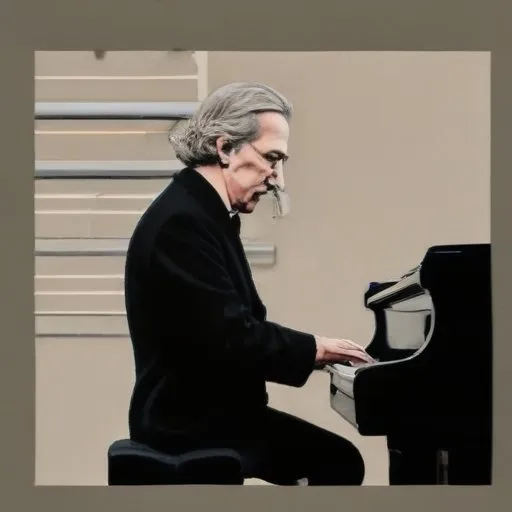
A renowned classical pianist celebrated for his poetic and introspective performances, particularly in the works of Mozart, Beethoven, and Schubert.
Renowned for his mesmerizing interpretations of Mozart and Beethoven, Richard Goode is an American classical pianist who has captivated audiences worldwide with his poetic and nuanced performances. With a career spanning over five decades, Goode has solidified his position as one of the most esteemed pianists of our time, celebrated for his technical mastery and profound understanding of the classical repertoire.
Born on June 1, 1943, in the East Bronx, New York, Goode began his piano studies at a young age. He went on to study at Mannes College, The New School for Music, where he worked with esteemed pianists Elvira Szigeti, Claude Frank, and Nadia Reisenberg. Furthering his education, Goode attended the Curtis Institute of Music in Philadelphia, Pennsylvania, where he was mentored by Rudolf Serkin and Mieczyslaw Horszowski.
Goode's impressive discography includes several iconic recordings, including his interpretations of Mozart's piano concerti with the Orpheus Chamber Orchestra and the music of Schubert, Schumann, Brahms, and Bach. Notably, he became the first American-born pianist to record the complete Beethoven piano sonatas, a testament to his dedication and artistic mastery.
Throughout his career, Goode has premiered works written specifically for him by prominent composers such as Carlos Chávez, George Perle, and Robert Helps. He has collaborated with esteemed chamber music partners, including soprano Dawn Upshaw, clarinetist Richard Stoltzman, and violinist Alexander Schneider.
Goode's contributions to the world of classical music have been recognized with numerous awards and honors. He is a Grammy Award winner for Best Chamber Music Performance, and has received the Avery Fisher Prize, the Sanford Medal from Yale University, and first prize in the Clara Haskil Competition, among others.
In addition to his performing career, Goode has been a dedicated educator, serving as a faculty member at Mannes College, The New School for Music. From 1999 to 2013, he was the Artistic Co-Director of the Marlboro Music School and Festival alongside Mitsuko Uchida. His influence on the next generation of pianists has been profound, shaping the course of classical music for years to come.
Goode is married to violinist Marcia Weinfeld, and has been featured in a literary portrait in David Blum's book "Quintet: Five Journeys toward Musical Fulfillment." This poignant portrayal originally appeared as an article in The New Yorker in 1992.
Through his remarkable career, Richard Goode has left an indelible mark on the world of classical music, inspiring generations of musicians and music lovers alike. His commitment to his craft, coupled with his passion for sharing the beauty of music, has cemented his place as one of the most revered pianists of our time.
92 Years Old
A renowned pianist and composer who won the inaugural International Tchaikovsky Piano Competition in 1958, earning international acclaim and recognition for his exceptional talent. He was a cultural ambassador, bridging the gap between the US and the Soviet Union during the Cold War era.
Born in 1903
A renowned pianist and educator, known for his expressive and nuanced performances of classical music, particularly the works of Beethoven and Brahms.
Born in 1819
A renowned 19th-century pianist and composer, she was one of the first females to achieve recognition in a male-dominated field, creating over 60 pieces of music. Her compositions showcased romanticism and lyricism.
Born in 1811
A virtuosic pianist and composer who revolutionized classical music with his technically demanding and emotionally expressive works, blending Hungarian folk influences with Romantic-era drama.
Born in 1833
A renowned pianist and composer, he crafted complex, expressive works that blended traditional and innovative techniques, leaving an indelible mark on classical music.
Born in 1810
A renowned Romantic-era composer and influential music critic, known for his expressive and emotionally charged works, including symphonies, piano music, and art songs.
Born in 1809
A renowned 19th-century musician who masterfully blended classical and romantic styles, creating iconic works like the "Wedding March" and "Elijah" oratorio. His compositions continue to inspire and influence generations of artists.
Born in 1822
A Belgian organist and composer who created iconic works that blended Romanticism and Impressionism, leaving a lasting impact on classical music.
