


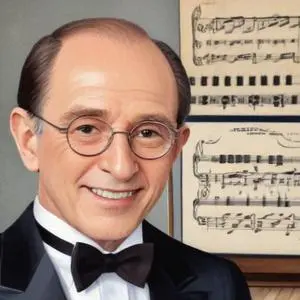
A renowned pianist and educator, known for his expressive and nuanced performances of classical music, particularly the works of Beethoven and Brahms.
Rudolf Serkin was a pianistic giant, renowned for his profound and nuanced interpretations of Ludwig van Beethoven's works. Widely regarded as one of the greatest Beethoven interpreters of the 20th century, Serkin's mastery of the composer's oeuvre earned him a revered place in the pantheon of classical music.
Born on March 28, 1903, in Eger, Kingdom of Bohemia (now Czech Republic), to a Russian Jewish family, Serkin's early life was steeped in music. His father, Mordko Serkin, a Russian basso, taught him to read music before he could read words. Recognized as a child prodigy, Serkin was sent to Vienna at the age of 9 to study piano with Richard Robert and, later, composition with Joseph Marx.
At 12, Serkin made his public debut with the Vienna Philharmonic, solidifying his reputation as a prodigious talent. He continued to study composition with Arnold Schoenberg, participating actively in Schoenberg's Society for the Private Performance of Music from 1918 to 1920. This formative period laid the foundation for Serkin's innovative approach to Beethoven's music.
Serkin's regular concert career began in 1920, with performances throughout Europe, both as a soloist and with the renowned Busch Quartet. His collaborations with Adolf Busch, a German violinist, were particularly fruitful, with the two musicians forming a lifelong musical partnership. In 1933, Serkin made his United States debut at the Coolidge Festival in Washington, D.C., marking the beginning of a long and successful career in America.
Serkin's Beethoven interpretations were characterized by their lyricism, nuance, and profound understanding of the composer's intent. His performances of Beethoven's piano sonatas, in particular, were hailed for their clarity, precision, and emotional depth. Serkin's unique approach to Beethoven's music was shaped by his studies with Schoenberg and his exposure to the composer's innovative Viennese circle.
Serkin's contributions to classical music were recognized with numerous awards, including the Presidential Medal of Freedom, the National Medal of Arts, and multiple Grammy Awards. He was also awarded honorary doctorates from institutions such as Harvard University and the Juilliard School.
Serkin's pedagogical influence extended far beyond his performances. He taught at the Curtis Institute of Music, where he helped shape the careers of countless pianists, including notable students such as Gary Graffman and Peter Serkin, his son. Serkin's legacy continues to inspire generations of pianists, ensuring the continued relevance and beauty of Beethoven's music.
Serkin married Irene Busch, daughter of Adolf Busch, in 1935. The couple had two children, including Peter Serkin, who became a celebrated pianist in his own right. Serkin's personal life was marked by a deep commitment to his family and a lifelong passion for music.
Serkin's contributions to classical music have had a lasting impact on modern society. His performances and recordings continue to inspire and educate audiences around the world, ensuring the enduring relevance of Beethoven's music. Serkin's legacy serves as a testament to the power of music to transcend time and cultural boundaries.
Serkin's approach to music was rooted in a deep respect for the composer's intent and a commitment to artistic integrity. His performances embodied a philosophical approach to music, one that valued nuance, subtlety, and emotional authenticity. Serkin's interpretations of Beethoven's music continue to influence pianists and inspire audiences today.
Born in 1891
A renowned violinist and composer, known for his expressive and nuanced performances, as well as his contributions to the development of chamber music.
Born in 1899
A renowned violinist and conductor, leading the Philadelphia Orchestra for over 40 years, known for his technical precision and interpretations of Romantic-era composers.
Born in 1875
A virtuosic violinist and composer, renowned for his mesmerizing performances and exquisite compositions that blended classical and romantic styles. His music still enchants audiences today.
Born in 1901
A virtuosic violinist renowned for his technical perfection, tone, and phrasing, revolutionizing the art of violin playing through his recordings and teaching.
Born in 1897
A renowned conductor and composer, known for his precise and expressive performances, leading the Cleveland Orchestra to international acclaim. His interpretations of classical music remain highly influential.
98 Years Old
A renowned pianist and conductor, celebrated for his poetic and introspective performances, particularly of Chopin and Debussy's works.
92 Years Old
A renowned pianist and composer who won the inaugural International Tchaikovsky Piano Competition in 1958, earning international acclaim and recognition for his exceptional talent. He was a cultural ambassador, bridging the gap between the US and the Soviet Union during the Cold War era.
81 Years Old
A world-renowned virtuoso, celebrated for mesmerizing performances and iconic recordings that have elevated the art of classical music.
