


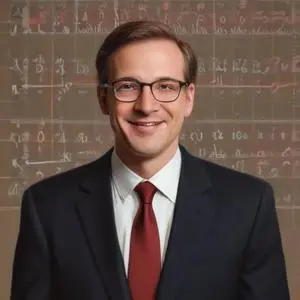
A pioneer in computer science and coding theory, he developed error-correcting codes and was a key figure in the development of modern computing.
Richard Hamming, a prolific American mathematician, is renowned for his groundbreaking contributions to computer engineering and telecommunications, particularly in the development of error-correcting codes. His eponymous Hamming code, a fundamental concept in digital communication, has had a profound impact on modern computing and data transmission.
Born on February 11, 1915, in Chicago, Illinois, Hamming grew up during the Great Depression. Despite the financial constraints, he managed to secure a scholarship to the University of Chicago, where he pursued his passion for science. He later attended the University of Nebraska and the University of Illinois at Urbana-Champaign, earning his Ph.D. in mathematics under the guidance of Waldemar Trjitzinsky in 1942.
Hamming's work on error-correcting codes revolutionized the field of digital communication. His Hamming code, which uses a Hamming matrix, enables the detection and correction of errors in digital data transmission. This innovation has far-reaching implications for modern computing, data storage, and communication systems.
In 1945, Hamming joined the Manhattan Project at the Los Alamos Laboratory, where he programmed IBM calculating machines to solve complex equations provided by the project's physicists. After the war, he joined Bell Telephone Laboratories in 1946, where he contributed to numerous groundbreaking projects over the next 15 years.
Hamming received the esteemed Turing Award in 1968, becoming its third recipient. He continued to work as an adjunct professor and senior lecturer in computer science at the Naval Postgraduate School in Monterey, California, after retiring from Bell Labs in 1976. Hamming delivered his final lecture in December 1997, just a few weeks before his passing on January 7, 1998.
Richard Hamming's remarkable contributions to computer science and telecommunications have left an indelible mark on modern computing and communication systems. His work continues to inspire and influence generations of mathematicians, computer scientists, and engineers.
Born in 1916
Developed the mathematical foundations of modern digital communication, creating the basis for modern computing and data transmission.
Born in 1912
Pioneering mathematician and computer scientist who cracked the German Enigma code during WWII and laid the foundations for modern computer science and artificial intelligence.
Born in 1903
Pioneering mathematician and physicist who developed the concept of the modern computer architecture and made significant contributions to quantum mechanics and game theory. His work laid the foundation for modern computing and artificial intelligence.
Born in 1906
A groundbreaking logician and philosopher who shook the foundations of mathematics with his incompleteness theorems, proving that no formal system can be both complete and consistent.
Born in 1882
A pioneering mathematician and physicist who revolutionized abstract algebra and made groundbreaking contributions to modern physics, particularly in the development of Einstein's theory of general relativity.
Born in 1845
Developed set theory, introducing infinite sets and cardinal numbers, revolutionizing mathematics and philosophy.
Born in 1862
A renowned mathematician and academic who developed infinite-dimensional vector spaces and laid the foundation for quantum mechanics and relativity. He's also famous for his 23 unsolved math problems that shaped 20th-century mathematics.
