


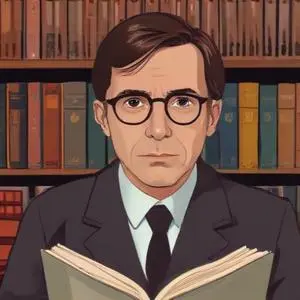
A Pulitzer Prize-winning historian and academic who wrote influential books on American history, politics, and culture, shaping the way we understand our nation's past and present.
Richard Hofstadter, an American historian and public intellectual, is renowned for his groundbreaking works on American history, politics, and culture. His most notable contributions include critiquing the liberal consensus and exposing the darker underbelly of American society, earning him two Pulitzer Prizes and a place among the most influential historians of the 20th century.
Born on August 6, 1916, in Buffalo, New York, Hofstadter's life took a dramatic turn when his mother, Katherine, passed away when he was just ten years old. Despite this early setback, he went on to attend Fosdick-Masten Park High School and later studied philosophy and history at the University at Buffalo, where he was mentored by the diplomatic historian Julius W. Pratt.
Hofstadter's academic career was marked by a series of influential works that shook the foundations of American historiography. Some of his most notable works include:
Hofstadter's work was characterized by a deep skepticism towards the dominant ideologies of his time. He rejected his earlier Marxist leanings and instead adopted a more nuanced, consensus-driven approach to history. He was critical of both socialist and capitalist models of society, arguing that they were bounded by the horizons of property and entrepreneurship.
Hofstadter's work had a profound impact on modern American society. His critiques of anti-intellectualism and the paranoid style in politics continue to resonate today. He was an elected member of the American Academy of Arts and Sciences and the American Philosophical Society, and his work continues to inspire new generations of historians, scholars, and thinkers.
Despite his academic success, Hofstadter's personal life was marked by tragedy. He lost his mother at a young age and later struggled with health issues. In 1936, he married Felice Swados, with whom he had a close and loving relationship.
Richard Hofstadter passed away on October 24, 1970, but his work continues to inspire and provoke. His legacy is one of intellectual honesty, critical inquiry, and a commitment to understanding the complexities of American society. As a historian, public intellectual, and critic, Hofstadter's contributions to American thought remain unparalleled.
"The most important thing about a principle is that it should be a principle, not just a policy."
"The paranoid style is an old and indigenous American phenomenon, and its development has been influenced by the social, economic, and political circumstances of the country."
"The anti-intellectualism of American life is not the product of a defect in the national character, but rather the consequence of a historical development."
These quotes offer a glimpse into Hofstadter's incisive mind and his commitment to critical thinking, intellectual honesty, and social commentary.
Born in 1908
A renowned historian and author who wrote extensively on the American South, shedding light on its complex history and racial dynamics. His works remain influential in understanding the region's past and its ongoing impact on modern society.
Born in 1908
A renowned economist and diplomat who served as the 7th United States Ambassador to India, known for his influential works on economics, particularly "The Affluent Society" and "The New Industrial State".
Born in 1922
A renowned sociologist and academic who studied the relationships between democracy, politics, and social structures, and is famous for his work on the "Lipset's Law" of economic development and democracy.
Born in 1892
A prominent mid-20th-century theologian and academic who developed the concept of "Christian realism," which emphasizes the role of sin and self-interest in human nature, influencing modern political and social thought.
Born in 1905
A prominent literary critic and educator, known for his insightful essays on 19th- and 20th-century literature, which continue to influence literary theory and criticism today.
Born in 1920
A prominent neoconservative thinker who founded a influential foreign policy magazine, shaping American political discourse and foreign policy debates.
