


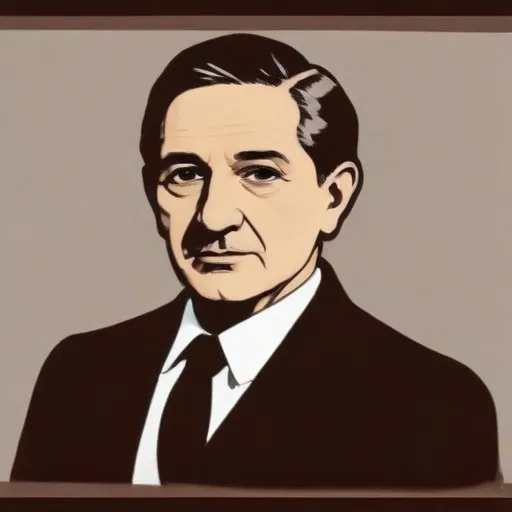
Developed the frequency interpretation of probability and made significant contributions to aerodynamics, particularly in the study of turbulence. His work has had a lasting impact on fields such as engineering, physics, and mathematics.
Richard von Mises, a renowned Austrian mathematician and philosopher, left an indelible mark on various fields, including solid mechanics, fluid mechanics, aerodynamics, statistics, and probability theory. His work, which spanned several decades, has had a significant impact on modern science and philosophy, earning him recognition as one of the most influential thinkers of the 20th century.
Born on April 19, 1883, in Lemberg, Austria-Hungary (now Lviv, Ukraine), Richard von Mises was the second of three brothers. His older brother, Ludwig von Mises, would go on to become a prominent economist, while his younger brother, Karl, sadly passed away in infancy. The von Mises family, of Jewish descent, valued education highly, and Richard's parents encouraged his early interest in mathematics and science.
Richard attended the Akademisches Gymnasium in Vienna, where he excelled in mathematics and Latin, graduating with honors in 1901. He then pursued his passion for mathematics at the University of Vienna, earning his Ph.D. in 1907.
Von Mises held various academic positions throughout his career, including professorships at the universities of Strasbourg, Dresden, and Berlin. In 1939, he emigrated to the United States, where he became the Gordon McKay Professor of Aerodynamics and Applied Mathematics at Harvard University, a position he held until his death in 1953.
Von Mises' contributions to mathematics and philosophy are vast and far-reaching. He made significant advances in the fields of:
Von Mises was a staunch empiricist and neopositivist, following in the footsteps of Ernst Mach. He believed that scientific knowledge should be based on empirical evidence and observation, rather than abstract theories or metaphysics. This philosophical stance is reflected in his work on the foundations of mathematics and the nature of probability.
His philosophical views often put him at odds with his brother Ludwig, who developed the opposing school of praxeology, focusing on human action and decision-making.
Von Mises maintained close relationships with prominent intellectuals, including Philipp Frank, a logical positivist and professor of physics, and the Austrian novelist Robert Musil. He was also an expert on the works of poet Rainer Maria Rilke.
Despite his many achievements, von Mises' life was not without challenges. He faced persecution as a Jew in Nazi Germany and was forced to flee to the United States, where he rebuilt his career.
Richard von Mises' contributions to mathematics, philosophy, and science have had a lasting impact on modern thought. His work continues to influence researchers and scholars across various disciplines, from aerospace engineering to philosophy of science.
As a testament to his legacy, von Mises' papers and lectures have been widely published and translated, ensuring that his ideas and insights remain accessible to future generations of scholars and thinkers.
"The only way to understand the universe is through mathematics."
"Probability is a measure of our ignorance, not of our knowledge."
These quotes capture the essence of von Mises' philosophical and mathematical outlook, emphasizing the importance of mathematical rigor and empirical evidence in understanding the world around us.
Von Mises received numerous awards and honors for his contributions to science and mathematics, including the Ludwig Prandtl Ring in 1933 and the Honorary Doctorate from Harvard University in 1943.
Today, Richard von Mises is remembered as a towering figure in the history of mathematics, philosophy, and science, whose work continues to inspire and challenge scholars across the globe.
Born in 1889
A philosopher who challenged traditional philosophy by emphasizing the importance of language and its limits, and is famous for his philosophical ideas on logic, reality, and the nature of meaning.
Born in 1906
A groundbreaking logician and philosopher who shook the foundations of mathematics with his incompleteness theorems, proving that no formal system can be both complete and consistent.
Born in 1885
A pioneer in combining mathematics and physics, known for his work on quantum mechanics, relativity, and the philosophy of science. He introduced the concept of gauge theory, which is crucial in modern particle physics.
Born in 1903
Pioneering mathematician and physicist who developed the concept of the modern computer architecture and made significant contributions to quantum mechanics and game theory. His work laid the foundation for modern computing and artificial intelligence.
Born in 1849
A pioneer in geometry and group theory, known for developing the Erlangen program, which unified various geometries under a single framework. His work laid foundations for modern algebraic geometry and topology.
Born in 1862
A renowned mathematician and academic who developed infinite-dimensional vector spaces and laid the foundation for quantum mechanics and relativity. He's also famous for his 23 unsolved math problems that shaped 20th-century mathematics.
Born in 1882
A pioneering mathematician and physicist who revolutionized abstract algebra and made groundbreaking contributions to modern physics, particularly in the development of Einstein's theory of general relativity.
