


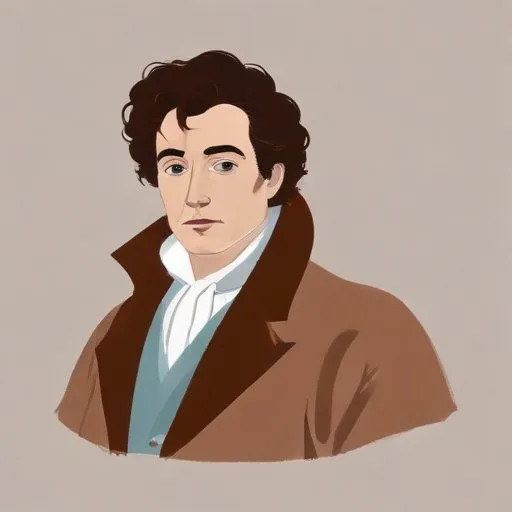
A leading Romantic poet and historian, known for his vivid storytelling and influential works on British history, particularly his three-volume "Life of Nelson".
Robert Southey, born on August 12, 1774, is renowned for his remarkable contributions to the Romantic school of poetry, earning him the prestigious title of Poet Laureate from 1813 until his passing in 1843. His most celebrated works include the thought-provoking poem "After Blenheim" and the original version of the beloved fairy tale "Goldilocks and the Three Bears."
Southey's journey began in Wine Street, Bristol, where he was born to Robert Southey and Margaret Hill. His academic pursuits took him to Westminster School, London, and later to Balliol College, Oxford, where he developed a passion for poetry and literature.
During his time at Westminster, Southey was expelled for writing an article in The Flagellant, a magazine he founded, which attributed the invention of flogging to the Devil. This bold move showcased his early radicalism and willingness to challenge authority.
Southey's writing talent was evident from an early age. In 1794, he published his first collection of poems, which was followed by a series of ballads and plays. Notably, he co-wrote The Fall of Robespierre with Samuel Taylor Coleridge, with whom he experimented with writing partnerships.
In 1795, Southey, Coleridge, Robert Lovell, and others discussed creating an idealistic community, pantisocracy, on the banks of the Susquehanna River in America. Although the project never materialized, it reflected Southey's utopian ideals and desire for social reform.
In 1795, Southey married Edith Fricker, and the couple spent time in Portugal, where he wrote Joan of Arc, published in 1796. He later traveled to Spain in 1800, after which he settled in the Lake District, where he continued to write and develop his literary style.
Southey's poetry and writings often reflected his shifting ideologies, as he transitioned from radicalism to conservatism. His later works demonstrated a growing respect for Britain and its institutions, which drew criticism from contemporaries like Lord Byron, who accused him of siding with the establishment for personal gain.
Robert Southey's literary contributions continue to influence modern society. His poems and stories have been translated into numerous languages, and his legacy extends to the realm of children's literature, where his version of "Goldilocks and the Three Bears" remains a beloved classic.
"All I learnt was a little swimming... and a little boating." - Robert Southey, reflecting on his time at Oxford
Through his remarkable life, literary achievements, and philosophical contributions, Robert Southey continues to inspire generations with his visionary ideas, creativity, and dedication to the world of words.
Born in 1770
A major Romantic poet, known for his focus on nature, emotion, and the human experience, creating works that evoke a sense of wonder and connection to the natural world.
Born in 1772
A leading figure of the Romantic movement, he crafted vivid, imaginative poetry and explored the human experience through his writing and philosophical ideas. His works continue to inspire and influence literature and art to this day.
Born in 1788
Romantic poet and playwright celebrated for passionate, expressive works that explored themes of love, freedom, and the human condition.
Born in 1792
Romantic-era writer of lyrical poetry and Gothic dramas that explored the human condition, freedom, and the beauty of nature.
Born in 1795
Romantic poet celebrated for sensual language and vivid imagery, capturing the beauty of nature and human experience in odes like "To Autumn" and "Ode to a Nightingale".
Born in 1797
Author of Gothic novels, particularly the iconic "Frankenstein", which has become a cultural phenomenon and influenced countless adaptations and reinterpretations.
Born in 1775
A celebrated author of witty, romantic novels of manners that offer insightful commentary on 19th-century English society, particularly the lives of women. Her works remain beloved for their strong female characters, clever dialogue, and nuanced exploration of relationships.
Born in 1771
A renowned author of historical novels, plays, and poetry, credited with creating the genre of historical fiction and influencing the development of the novel as a literary form.
