


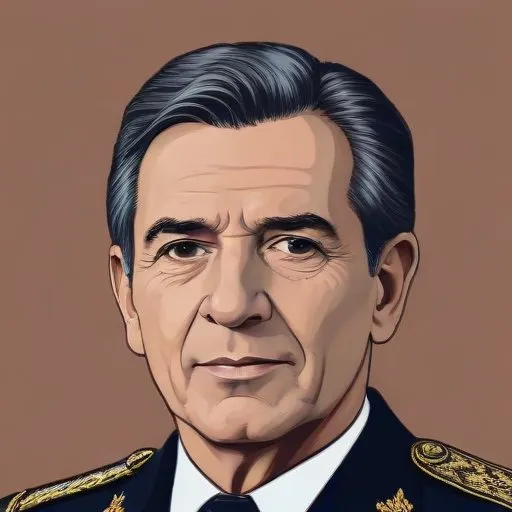
Argentinian general and politician who served as the 36th President of Argentina, known for his brief but tumultuous tenure marked by economic crisis and human rights abuses.
Roberto Marcelo Levingston was a Argentine general and politician who served as the de facto President of Argentina from 1970 to 1971. He is known for his authoritarian rule and his role in the country's tumultuous history during the 1970s.
Levingston was born on January 22, 1920, in San Luis, Argentina. He graduated from the Argentine Military Academy in 1941 and quickly rose through the ranks of the Argentine military. In 1966, he became the Commander-in-Chief of the Argentine Army, a position that gave him significant influence in the country's politics.
In June 1970, Levingston was appointed as the President of Argentina by the military junta that had overthrown President Juan Carlos Onganía. During his presidency, Levingston ruled with an iron fist, imposing strict censorship, banning political parties, and restricting civil liberties. His government was marked by human rights abuses, including the use of torture and forced disappearances.
Levingston's economic policies were centered around the idea of "national capitalism," which aimed to promote Argentine industries and reduce the country's dependence on foreign capital. However, his policies were criticized for being authoritarian and favoring the interests of the military and the oligarchy over those of the working class. His government was also plagued by corruption scandals, including allegations of embezzlement and cronyism.
In March 1971, Levingston was ousted from power in a bloodless coup led by General Alejandro Lanusse, who would go on to become the next President of Argentina. Levingston's legacy is marked by controversy and human rights abuses, and he is widely regarded as one of the most authoritarian and repressive leaders in Argentine history.
Levingston died on June 17, 2015, at the age of 95, in Buenos Aires, Argentina. His personal life was marked by secrecy and he rarely spoke to the press or made public appearances.
Levingston's authoritarian rule and human rights abuses have been compared to those of other Latin American dictators, such as Chile's Augusto Pinochet and Uruguay's Juan María Bordaberry. However, while these leaders were able to maintain power for longer periods, Levingston's rule was marked by instability and his eventual ouster from power.
Levingston's presidency marked a turning point in Argentine politics, as it highlighted the country's deep-seated problems of authoritarianism, corruption, and human rights abuses. His rule also led to a period of political instability and violence, which would continue to affect the country for decades to come.
Born in 1919
A former actress who used her charisma and influence to advocate for women's suffrage and workers' rights, becoming a beloved and powerful figure in Argentine politics.
99 Years Old
The first democratically elected president of Argentina after a period of military rule, known for his efforts to promote human rights and democracy in the country.
96 Years Old
The 50th President of Argentina, a lawyer-turned-politician who implemented neoliberal economic policies and pardoned military officers involved in human rights abuses during the country's Dirty War. He's also known for his flamboyant style and corruption scandals.
88 Years Old
Led Argentina through a tumultuous period, implementing economic reforms and navigating corruption scandals, while also being a key figure in the country's transition to democracy. Known for his efforts to stabilize the economy and promote human rights.
84 Years Old
A lawyer and politician who served as President of Argentina from 2002 to 2003, known for navigating the country's economic crisis and defaulting on its foreign debt. He implemented austerity measures to stabilize the economy.
76 Years Old
The 51st President of Argentina, who served from 2003 to 2007, is known for his efforts to rebuild the country's economy and restore its international reputation after a severe crisis. He's also recognized for his human rights advocacy and social welfare programs.
