


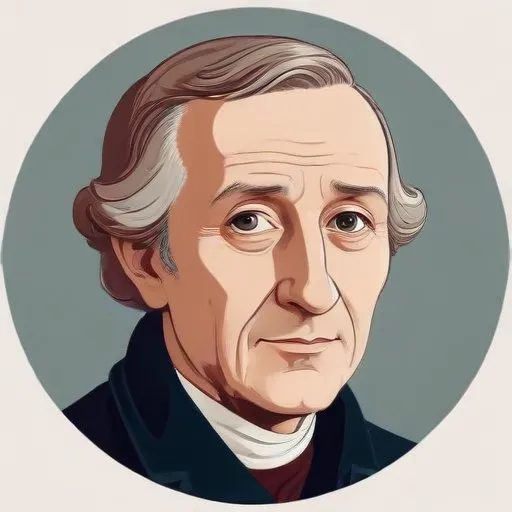
Developed innovative mathematical techniques and made significant contributions to the field of astronomy, particularly in the study of celestial mechanics.
Roger Cotes is renowned for his meticulous proofreading of Isaac Newton's seminal work, Philosophiæ Naturalis Principia Mathematica, and for developing the quadrature formulas known as Newton-Cotes formulas. His groundbreaking contributions to mathematics and astronomy have left a lasting impact on the scientific community.
Born on July 10, 1682, in Burbage, Leicestershire, Cotes was the son of Robert, the rector of Burbage, and his wife, Grace. He had an elder brother, Anthony, and a younger sister, Susanna, both of whom died at a young age. Cotes's mathematical talent was recognized at Leicester School, where he was encouraged by his aunt Hannah's husband, Rev. John Smith, who took on the role of his tutor.
Cotes's academic career began at St Paul's School in London, followed by his admission to Trinity College, Cambridge, in 1699. He graduated with a BA in 1702 and an MA in 1706. In 1707, he became a fellow of Trinity College and, at the age of 26, was appointed the first Plumian Professor of Astronomy and Experimental Philosophy.
Cotes's work laid the foundation for modern computational methods in astronomy and mathematics. He designed a heliostat telescope with a mirror revolving by clockwork in correspondence with Isaac Newton. Additionally, he recomputed the solar and planetary tables of Giovanni Domenico Cassini and John Flamsteed, intending to create tables of the moon's motion based on Newtonian principles.
Cotes's invention of the quadrature formulas, known as Newton-Cotes formulas, has had a profound impact on numerical analysis. Furthermore, his geometric argument can be interpreted as a logarithmic version of Euler's formula, demonstrating his innovative approach to mathematical problem-solving.
Cotes's untimely death on June 5, 1716, cut short his promising career, but his contributions continue to influence modern science. As the first Plumian Professor at Cambridge University, he paved the way for future generations of mathematicians and astronomers. His work alongside Newton has left an indelible mark on the history of science, cementing his place as a pioneer in his field.
Cotes's close association with Robert Smith, the son of his aunt's husband, Rev. John Smith, is a testament to the strong bonds he formed during his early years. This friendship played a significant role in nurturing his mathematical talent and supporting his academic pursuits.
Cotes's work must be viewed in the context of the scientific revolution of the 17th century, which saw the emergence of giants like Newton and Gottfried Wilhelm Leibniz. A comparative analysis of Cotes's contributions with those of his contemporaries reveals his unique approach to mathematical problem-solving and his ability to build upon the work of others.
Roger Cotes's remarkable achievements in mathematics and astronomy have secured his place in the annals of scientific history. His tireless efforts to proofread Newton's Principia, his invention of the Newton-Cotes formulas, and his contributions to astronomy continue to inspire new generations of scientists and mathematicians.
Born in 1656
Predicted celestial events, including the return of a comet that bears his name, and made significant contributions to navigation, astronomy, and mathematics.
Born in 1646
Developed calculus independently of Isaac Newton, and made major contributions to the fields of philosophy, politics, and history.
Born in 1646
England's first Astronomer Royal, mapping the stars and creating a catalog of celestial bodies, laying the foundation for modern astronomy.
Born in 1633
A 17th-century diarist and politician who chronicled his daily life, including significant historical events like the Great Fire of London, in a candid and detailed manner. His diary is a valuable historical resource and a window into the past.
Born in 1629
A 17th-century polymath who made groundbreaking contributions to optics, probability theory, and astronomy, including the discovery of Saturn's rings and the largest moon, Titan.
Born in 1508
An Italian Renaissance astronomer and philosopher who wrote influential works on astronomy, philosophy, and literature, including a commentary on Aristotle's "De Caelo".
