


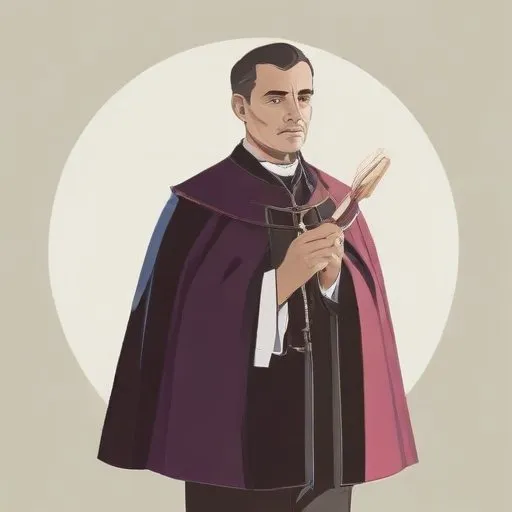
A Spanish priest and engineer who designed and built innovative hydraulic systems and machines, including a famous self-propelled submarine in the 18th century.
Fr. Roque Ruao Garrido, O.P. is renowned for designing the University of Santo Tomas (UST) Main Building, the first earthquake-shock resistant building in Asia, constructed in Manila, Philippines. This iconic edifice not only showcased his exceptional engineering skills but also paved the way for modern architecture in the region.
Born on August 16, 1877, in Palencia, Spain, Fr. Ruao submitted himself to the Dominican Order in 1894. He arrived in the Philippines on July 21, 1904, and served his first few years in the Colegio de San Juan de Letran as Father Rector.
Fr. Ruao's thirst for knowledge led him to pursue a Doctorate in Civil Engineering from the University of Santo Tomas. He practiced his expertise by designing and building various infrastructure projects, including the Dominican Residences in Baguio and Lingayen, Pangasinan.
The UST Main Building, Fr. Ruao's magnum opus, has withstood the test of time, surviving World War II, natural disasters, and political upheavals. This architectural marvel was built with seismic resistance in mind, a pioneering concept at the time. Modern studies have confirmed that the building's design meets current building code and regulation standards.
Fr. Ruao was a dedicated professor at the University of Santo Tomas, teaching mineralogy, geology, and harbors and lighthouses. He also served as the Dean of the College and Regent from 1930 to 1935. His expertise was sought after in international conventions, including Tokyo (1926), Ravenna (1931), and London (1932).
Fr. Ruao's untimely death on March 1, 1935, due to heart failure, was met with widespread mourning. In recognition of his groundbreaking contributions, an edifice was named after him in the University of Santo Tomas.
Fr. Ruao's innovative approach to seismic-resistant design has left an indelible mark on modern architecture. His work has inspired generations of engineers and architects, shaping the course of infrastructure development in Asia and beyond.
Fr. Roque Ruao Garrido's remarkable story serves as a beacon of inspiration, reminding us that visionary thinking and innovative design can leave a lasting impact on our world.
Born in 1806
A visionary engineer who revolutionized transportation with innovative designs, including the iconic Clifton Suspension Bridge, which transformed urban landscapes.
Born in 1832
Co-designer of the iconic Eiffel Tower, a pioneering engineer who revolutionized bridge building and urban infrastructure with innovative iron constructions.
Born in 1805
A French diplomat and engineer who developed the Suez Canal, a crucial waterway connecting the Mediterranean Sea to the Red Sea, revolutionizing global trade and commerce.
Born in 1736
Improved steam engine efficiency, revolutionizing industry and transportation. Known for his innovative designs and patents that transformed the Industrial Revolution.
Born in 1623
A 17th-century genius who made major contributions to mathematics, physics, and philosophy, inventing the mechanical calculator and developing the theory of probability. His writings also explored the human condition and faith.
Born in 1452
Renaissance mastermind behind iconic works like the Mona Lisa and The Last Supper, who revolutionized art, science, and engineering with his inventive and curious nature.
