


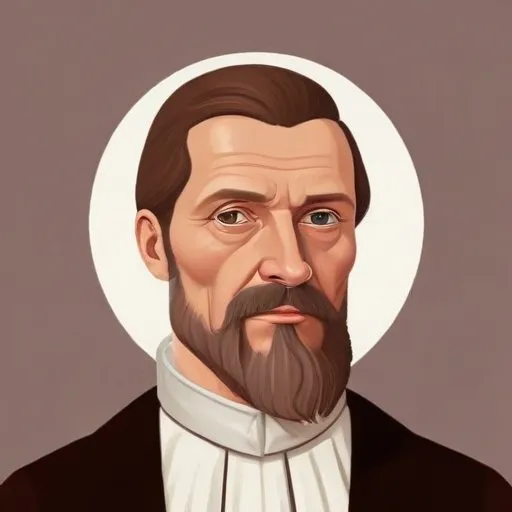
A 16th-century German philosopher and lexicographer who coined many philosophical terms and wrote influential dictionaries, shaping the development of modern philosophical language.
Rudolph Goclenius, a 16th-century German philosopher, is renowned for coining the term "psychology" in 1590, although the term had been used by Marko Maruli 66 years earlier. Goclenius made significant contributions to the field of ontology, extending the development of many ideas from Aristotle.
Rudolph Goclenius was born on March 1, 1547, in Korbach, Waldeck (now in Waldeck-Frankenberg, Hesse) as Rudolf Gockel or Gökkel. He attended the universities at Erfurt, Marburg, and Wittenberg, where he finished his studies with a Master's degree in 1571.
In the following years, Goclenius directed the gymnasiums in his hometown Korbach (1573) and in Kassel (Michaelmas 1575). In 1581, he was appointed professor at the Philipps University of Marburg, where he held the chairs of physics, logic, mathematics, and ethics. He served as a counselor to Landgrave Wilhelm IV of Hesse-Kassel and his son Moritz.
Goclenius' major contribution was to the field of ontology, where he developed and extended Aristotle's ideas. He gave the philosophy a name and continued in Aristotle's way of thinking. The philosophical discipline of ontology is thought to have been developed in the 17th century by Goclenius.
Goclenius published several works, including Analecta Lichae in 1598, which he considered his best work. His writings had a significant impact on later philosophers, who built upon his ideas.
Goclenius' influence extended beyond the academic sphere. He was sent to the Synod of Dort in 1618, where he played a significant role. His work in ontology and psychology paved the way for future philosophers, cementing his legacy in the history of philosophy.
In his old age, Goclenius was the subject of a satirical text by Johann Balthasar Schupp. Jeremias Nicolai, a student at Korbach Stadtschule, reported that Goclenius immediately wrote a poem about fiery air phenomena (feurige Lufterscheinungen).
Rudolph Goclenius' contributions to philosophy, particularly in the fields of ontology and psychology, have left a lasting impact on the history of philosophy. His work continues to influence philosophers to this day, making him a significant figure in the development of modern thought.
Born in 1497
A 16th-century Renaissance scholar who made significant contributions to the development of the Protestant Reformation and education, known for his theological writings and astronomical observations.
Born in 1483
A German monk and priest who sparked the Protestant Reformation, challenging Catholic Church authority and shaping Western Christianity. He's famous for nailing 95 theses to a church door, sparking a religious revolution.
Born in 1533
A 16th-century physician and scholar who wrote extensively on medicine, philosophy, and literature, and is particularly notable for his work on the concept of melancholy.
Born in 1525
A 16th-century physician and scholar who made significant contributions to the fields of medicine, mathematics, and astronomy, and was a prominent figure in the Lutheran Reformation.
Born in 1500
A 16th-century German scholar and translator who produced influential Latin translations of ancient Greek texts, making classical knowledge accessible to a broader audience.
Born in 1516
A 16th-century Renaissance polymath who cataloged and described thousands of plants and animals, laying the foundations for modern taxonomy and zoology.
