


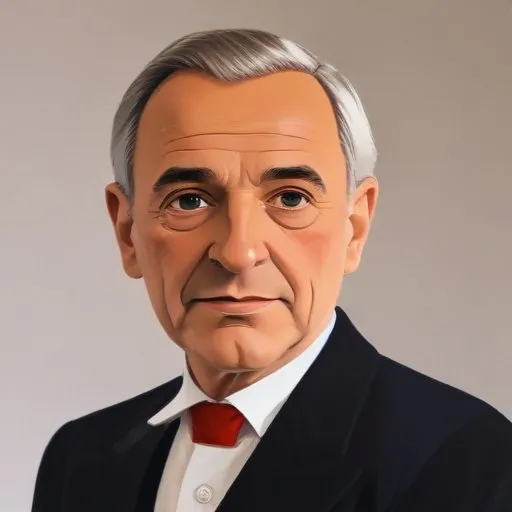
A pioneer of Op Art, creating vibrant, geometric paintings and sculptures that explore the emotional and psychological effects of color on the human psyche.
Rupprecht Geiger, a German abstract painter and sculptor, is renowned for his bold and vibrant colorfield paintings, often focused on the subtleties of a single hue. His artistic trajectory is characterized by an unwavering dedication to the exploration of color, particularly the color red, which dominated his work in the 1950s.
Geiger was born on January 26, 1908, in Munich, Germany, to Willi Geiger, a painter. His early life was marked by frequent travels with his father to Spain, Morocco, and the Canary Islands, where he began painting. This exposure to diverse cultures and landscapes undoubtedly influenced his artistic development.
From 1926 to 1935, Geiger studied and taught architecture and art at various academic institutions in Munich. This dual expertise in art and architecture would later inform his approach to painting.
During World War II, Geiger was conscripted to fight on the Eastern Front in Poland and Russia, and later served as a war illustrator in the Ukraine and Greece. This tumultuous period marked a turning point in his artistic journey. In 1948, he exhibited his first abstract painting, signaling a departure from his previous representational style.
In 1949, Geiger co-founded the Munich artists' group ZEN 49, a collective that sought to promote non-representational art. His work caught the attention of Hilla von Rebay, who exhibited his paintings at the Museum for Non-Objective Painting (now the Guggenheim Foundation).
From 1965 to 1976, Geiger taught painting at the Staatlichen Kunstakademie Düsseldorf, influencing a new generation of artists. His own work continued to evolve, characterized by simple geometric forms, bright colors, and intense contrasts.
Geiger's work has been featured in numerous international exhibitions, including four documenta exhibitions in Kassel (1959, 1964, 1968, and 1977). He received several prestigious awards, including the Kultureller Ehrenpreis der Landeshauptstadt München (1989), The Rubens Prize of the City of Siegen (1992), the Oberbayerischer Kulturpreis (1995), and the Kulturpreis der Stadt München (1997).
Rupprecht Geiger's contributions to modern art are undeniable. His work has inspired generations of artists, and his focus on color and abstraction has expanded the boundaries of the medium. The Diozesanmuseum Freising near Munich houses an extensive collection of his works, a testament to his enduring influence on the art world.
Through his innovative approach to color and form, Geiger has left an indelible mark on the world of abstract art, cementing his place as a master of monochromatic abstraction.
Born in 1866
A pioneer of abstract art, creating vibrant, expressive works that explored the emotional and spiritual properties of color, and wrote extensively on art theory.
Born in 1880
A German soldier-turned-painter who pioneered Expressionism, capturing the emotional essence of animals and landscapes in vibrant, abstracted forms. His work continues to inspire artists and art lovers alike.
Born in 1887
A pioneering expressionist painter who captured the vibrant spirit of early 20th-century Europe through bold, colorful works that blended Fauvism and Cubism. His innovative style continues to inspire artists today.
Born in 1864
A Russian-German painter who pioneered Expressionism, capturing intense emotions through vibrant, distorted forms and bold colors. He's famous for his bold, avant-garde portraits.
Born in 1871
A German-American painter and illustrator who blended cubism and futurism to create vibrant, abstracted cityscapes and seascapes, influencing the development of modern art.
Born in 1879
A Swiss-German artist and educator who blended fantasy and reality in his vibrant, whimsical paintings, exploring the emotional and expressive qualities of color. His unique style has inspired generations of artists.
Born in 1885
A pioneer of Orphism, a style of abstract art that emphasizes geometric shapes and vibrant colors, creating dynamic and expressive works that explore the emotional potential of color. 42
